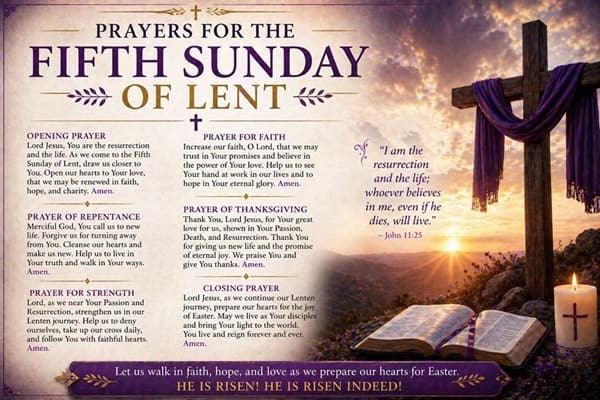
259 Prayers for the Fifth Sunday of Lent for Passiontide
The fifth Sunday of Lent is different. The atmosphere shifts. The purple vestments get deeper. The crosses in the church are veiled. The hymns grow more urgent. This Sunday marks the beginning of Passiontide. The final stretch toward Holy Week. The suffering of Christ comes into sharper focus.
Many people miss this shift. They know Ash Wednesday. They know Palm Sunday. But the fifth Sunday of Lent sits between them like a bridge. A bridge from the desert to the cross. On this Sunday, the readings turn dark. Jesus speaks of His hour coming. The enemies close in. The disciples do not understand. Tension builds.
This collection gives you 259 prayers for the fifth Sunday of Lent. The number matches the traditional count of hours from this Sunday to Easter morning. From the veil of Passiontide to the unveiling of the empty tomb. One prayer for each hour of waiting. For each hour of watching.
You do not need to pray all 259 on this single Sunday. Keep these prayers for the whole week that follows. From the fifth Sunday to Palm Sunday. From Passiontide to the triumphal entry. Let the prayers carry you through the final days of Lent.
These prayers follow the readings of the fifth Sunday. Year A, Year B, and Year C. The raising of Lazarus. The grain of wheat falling to the ground. The woman caught in adultery. Each Gospel has its own focus. Each prayer fits.
Let us enter Passiontide. The veil is drawn. The cross is hidden. But not for long.
The Raising of Lazarus (Year A)
In Year A of the lectionary, the fifth Sunday of Lent tells the story of Lazarus. Jesus receives word that His friend is sick. He delays two days. By the time He arrives, Lazarus has been dead for four days. Martha meets Him. Mary meets Him. Jesus weeps. Then He calls Lazarus out of the tomb. The man who was dead comes out, still wrapped in grave clothes.
This is the last great sign before Holy Week. John places it here to show that Jesus has power over death. The same power He will demonstrate on Easter. These prayers walk through that story. The waiting. The grief. The miracle.
Prayer 1. Jesus, You loved Lazarus. You loved Mary and Martha. Love me this Passiontide.
Prayer 2. The message came to You. Your friend is sick. You did not rush. You waited. Teach me to trust Your timing.
Prayer 3. The delay felt like cruelty. But it was not. The delay was for glory. My delays are for glory too.
Prayer 4. Lazarus died. The sisters grieved. The mourners came. Death is real. Grief is real. Sit with me in my grief.
Prayer 5. Martha went out to meet Jesus. She said, if You had been here, my brother would not have died. I have said the same. If You had been here. Be here.
Prayer 6. Martha believed that Jesus could ask God for anything. Her faith was strong. Strengthen my faith.
Prayer 7. Jesus said, your brother will rise again. Martha knew about the last day. But she did not know about this day. Teach me about this day.
Prayer 8. I am the resurrection and the life. Whoever believes in Me will live, even if they die. Those words are for me. I believe.
Prayer 9. Martha went to get Mary. Mary came quickly. She fell at Jesus’ feet. She said the same words. If You had been here. Let me fall at Your feet.
Prayer 10. Jesus saw Mary weeping. He saw the mourners weeping. He was deeply moved. He was troubled. Your heart breaks with mine.
Prayer 11. Jesus wept. The shortest verse. The deepest verse. He wept for Lazarus. He weeps with me.
Prayer 12. The people said, see how He loved him. They saw the love in the tears. Let others see my love in my tears.
Prayer 13. Some asked, could not He who opened the blind man’s eyes have kept Lazarus from dying? I ask the same. Could You not have prevented this? Help me trust the answer.
Prayer 14. Jesus went to the tomb. A cave with a stone. Take away the stone. Martha objected. The smell. Jesus insisted. Take away the stone.
Prayer 15. Jesus prayed. Father, thank You for hearing me. You always hear Me. Thank You for always hearing me.
Prayer 16. He cried out with a loud voice. Lazarus, come out. The dead man heard. The dead man came. Call me out of my death.
Prayer 17. Lazarus came out, his hands and feet wrapped in grave clothes. His face covered. Jesus said, unbind him. Let him go. Unbind me.
Prayer 18. The miracle was not just resurrection. It was unbinding. The grave clothes had to come off. Take off my grave clothes.
Prayer 19. Many who saw believed. Some went and told the Pharisees. The same miracle produced belief and betrayal. My response is my choice.
Prayer 20. The Pharisees gathered the Council. What are we doing? This man performs many signs. If we let Him go on, everyone will believe. Fear drove them.
Prayer 21. Caiaphas spoke. You do not realize that it is better for one man to die than for the whole nation to perish. He prophesied without knowing. Jesus would die for the nation.
Prayer 22. From that day on, they plotted to kill Jesus. The miracle of Lazarus sealed His fate. The sign led to the cross. Let the signs in my life lead me to You.
Prayer 23. Jesus no longer walked openly among the Jews. He withdrew. He waited. He knew His hour had not yet come. Teach me to wait.
Prayer 24. Mary anointed Jesus with expensive perfume. The house filled with fragrance. She prepared Him for burial. Let my worship perfume the room.
Prayer 25. Lazarus sat at the table with Jesus. The dead man was alive. He was eating. He was talking. He was proof. Let my life be proof.
Prayer 26. The chief priests planned to kill Lazarus too. Because many were believing because of him. The witness is dangerous. Keep me faithful even when witness costs.
Prayer 27. The next day, Palm Sunday. The crowds came. They had heard about Lazarus. They wanted to see Jesus and the man raised from the dead. The miracle drew the crowd.
Prayer 28. The raising of Lazarus is a preview of Easter. The same power that raised a four day dead man raised Jesus. That power raised me.
Prayer 29. Lazarus died twice. Once in Bethany. Once later. He died the second death of every human. But the first resurrection was enough. It proved the power.
Prayer 30. Jesus is the resurrection. Not just at the end. Now. He is resurrection now. Raise what is dead in me.
Prayer 31. The stone had to be rolled away. The stone of unbelief. The stone of fear. The stone of pride. Roll it away.
Prayer 32. The voice of Jesus is louder than death. Death heard. Death obeyed. My death will hear. My death will obey.
Prayer 33. The grave clothes are the things that bind me. Habits. Sins. Regrets. Unbind me. Let me go.
Prayer 34. Martha believed in the last day. Jesus offered the same day. Today is the day of resurrection. Believe today.
Prayer 35. Mary stayed at the house until Jesus called. She did not run out like Martha. She waited. Both were loved. Both were right.
Prayer 36. The mourners were there for four days. Jewish tradition said the soul lingered for three days. On the fourth day, all hope was gone. Jesus came on the fourth day. He comes when hope is gone.
Prayer 37. Jesus waited two days before going. He was not cruel. He was purposeful. The purpose was glory. My waiting has purpose.
Prayer 38. The word came to Jesus. The one You love is sick. Jesus loved Lazarus. Jesus loved Martha. Jesus loved Mary. The sickness did not mean He did not love. My sickness does not mean He does not love.
Prayer 39. The sickness was for God’s glory. The sickness had a purpose. My sickness has a purpose. Show me the glory.
Prayer 40. Jesus was glad He was not there when Lazarus died. So that they might believe. The absence was for faith. My sense of Your absence is for my faith.
Prayer 41. Thomas said, let us also go, that we may die with Him. Thomas was loyal. He did not understand. But he went. Let me go even when I do not understand.
Prayer 42. The tomb was a cave. The stone was large. But Jesus did not need a rolling stone to raise the dead. He spoke. The stone moved. His word moves stones.
Prayer 43. Lazarus came out still bound. Resurrection is not the same as complete freedom. The unbinding takes community. The community unbinds me.
Prayer 44. The Pharisees were afraid of losing their place. Their power. Their position. They chose position over truth. Forgive me when I do the same.
Prayer 45. Caiaphas spoke truth without knowing it. God can use anyone to speak truth. Even my enemies. Even me.
Prayer 46. Jesus withdrew from public ministry. Not because He was afraid. Because His hour had not come. He knew the timing. Help me know my timing.
Prayer 47. The perfume was worth a year’s wages. Judas objected. He pretended to care for the poor. He cared for the money. Let my objections be pure.
Prayer 48. Jesus said, leave her alone. She has kept this for the day of My burial. The perfume was prophetic. Let my actions be prophetic.
Prayer 49. The poor will always be with you. Jesus did not dismiss the poor. He prioritized His burial. There is a time for anointing. There is a time for giving. Discern the time.
Prayer 50. Fifty prayers for the raising of Lazarus. Death is not the end. The stone is not final. The voice of Jesus is louder.
The Grain of Wheat (Year B)
In Year B of the lectionary, the fifth Sunday of Lent focuses on John chapter 12. Some Greeks come to see Jesus. They ask Philip. Philip tells Andrew. They tell Jesus. Jesus responds with a strange saying. The hour has come. Unless a grain of wheat falls into the ground and dies, it remains alone. But if it dies, it bears much fruit.
This is the heart of Passiontide. Death leads to life. Sacrifice leads to abundance. The cross is not a tragedy. It is a harvest. These prayers dig into that mystery.
Prayer 51. Some Greeks came to worship at the feast. They wanted to see Jesus. The world was seeking Him. The world still seeks.
Prayer 52. Philip told Andrew. Andrew and Philip told Jesus. They brought the seekers to the Savior. Bring seekers to me. Bring me to seekers.
Prayer 53. Jesus answered. The hour has come for the Son of Man to be glorified. Not the hour of the Greeks. The hour of the cross. The cross is glory.
Prayer 54. Unless a grain of wheat falls to the ground and dies, it remains alone. A single seed. Alone. But if it dies, it produces many seeds. The many come from the one.
Prayer 55. Jesus is the grain. He fell into the ground of death. He died. He produced a harvest. The harvest is us.
Prayer 56. I am a grain too. I must fall. I must die. Not physical death. The death of my will. The death of my selfishness.
Prayer 57. The grain that does not die remains alone. Isolation is the fruit of selfishness. Community is the fruit of sacrifice.
Prayer 58. Whoever loves their life loses it. Clinging to life kills life. Letting go saves life. Let me let go.
Prayer 59. Whoever hates their life in this world will keep it for eternal life. Hate in this sense means prefer less. Prefer less of this life. Prefer more of the next.
Prayer 60. Whoever serves Me must follow Me. Where I am, My servant will also be. The servant follows the Master. Where is Jesus? At the cross. Follow.
Prayer 61. My Father will honor the one who serves Me. Not worldly honor. Eternal honor. That is enough.
Prayer 62. Jesus was troubled. His soul was troubled. He faced the cross with real human emotion. He was not a stoic. He was a feeler. My emotions are not weakness.
Prayer 63. He said, what can I say? Father, save Me from this hour? No. For this purpose I came to this hour. He faced the purpose. Face your purpose.
Prayer 64. Father, glorify Your name. Then a voice came from heaven. I have glorified it, and I will glorify it again. The Father spoke. The Son obeyed.
Prayer 65. The crowd heard thunder. Some said an angel spoke. They heard but did not understand. I hear but often do not understand. Help me listen anyway.
Prayer 66. Jesus said, this voice was for your benefit, not mine. The Father spoke for the crowd. He speaks for me.
Prayer 67. Now is the judgment of this world. Now the ruler of this world will be cast out. The cross was judgment. The cross was victory.
Prayer 68. When I am lifted up, I will draw all people to Myself. The cross is a magnet. It draws sinners. It draws saints. It draws me.
Prayer 69. He said this to show the kind of death He would die. Lifted up on a cross. Lifted up in glory. The same word serves both.
Prayer 70. The crowd asked, who is this Son of Man? The title was mysterious. The answer was the cross. The cross reveals.
Prayer 71. Jesus said, the light is among you for a little while. Walk while you have the light, so that darkness will not overtake you. Walk in the light of Passiontide.
Prayer 72. Believe in the light so that you may become children of light. Belief is not passive. It is becoming. Become a child of light.
Prayer 73. The grain of wheat teaches me that fruit comes from death. My ambitions must die. My reputation must die. My comfort must die.
Prayer 74. The seed does not ask why it must fall. It falls. It dies. It bears fruit. Do not ask why. Fall. Die. Bear.
Prayer 75. One seed becomes a stalk. The stalk has many seeds. Each seed can become a stalk. The multiplication is exponential. My sacrifice multiplies.
Prayer 76. The Greeks wanted to see Jesus. They saw Him. They saw the one who would die for them. See Jesus. See the grain.
Prayer 77. The hour had come. All of Jesus’ life pointed to this hour. The hour of the cross. My life points to its own hours. Face them.
Prayer 78. Glorify Your name. Not my name. Not my reputation. Not my comfort. Your name. Glorify it.
Prayer 79. The voice came from heaven. The Father spoke. The Son obeyed. The Spirit hovered. The Trinity was present at the cross. The Trinity is present with me.
Prayer 80. The ruler of this world is cast out. Satan lost at the cross. He lost his power. He still roars. He still accuses. But he lost.
Prayer 81. When I am lifted up. The cross is an elevation. Not just suffering. Exaltation. The cross is the throne.
Prayer 82. I will draw all people to Myself. Not some. All. The cross is universal. The invitation is open. Come.
Prayer 83. Walk while you have the light. The light of Passiontide is bright. Do not waste it. Walk.
Prayer 84. Darkness overtakes those who do not walk in the light. The darkness is not punishment. It is consequence. Stay in the light.
Prayer 85. Believe in the light. Not just intellectually. Trust the light. Lean on the light. Live in the light.
Prayer 86. Become children of light. Not born that way. Made that way. The cross makes children of light.
Prayer 87. The grain of wheat is a small thing. Easy to overlook. But the harvest is everything. Do not despise small sacrifices.
Prayer 88. The earth receives the seed. The seed disappears. The ground looks empty. But underneath, life is stirring. The emptiness is not empty.
Prayer 89. The seed dies. The shell cracks. The root goes down. The shoot goes up. The pattern is death, then life. Always.
Prayer 90. The fruit is not for the seed. The fruit is for others. My sacrifice is not for me. It is for the harvest.
Prayer 91. The grain of wheat does not calculate the cost. It does not negotiate. It falls. It dies. Be like the grain.
Prayer 92. The Greeks were outsiders. They sought Jesus. Jesus welcomed them. The seed died for outsiders. For me.
Prayer 93. Philip and Andrew brought the Greeks to Jesus. They were intermediaries. Be an intermediary. Bring seekers to Jesus.
Prayer 94. Jesus did not perform a sign for the Greeks. He told them about the grain. The sign was the cross. The cross is enough.
Prayer 95. The voice from heaven was for the crowd. They needed to hear. I need to hear. Speak.
Prayer 96. The crowd heard thunder. Some heard an angel. The same sound, different interpretations. The cross is the same. Different responses.
Prayer 97. Jesus said the voice was for your benefit. The Father’s affirmation was for the disciples. They needed to know. I need to know.
Prayer 98. The hour is the center of John’s Gospel. Everything leads to the hour. Everything flows from the hour. The hour is the cross.
Prayer 99. The grain of wheat is Jesus. The grain of wheat is also me. I must fall. I must die. I must bear fruit.
Prayer 100. One hundred prayers. The grain dies. The harvest comes. The cross is the pattern. The resurrection is the promise.
The Woman Caught in Adultery (Year C)
In Year C of the lectionary, the fifth Sunday of Lent tells the story of the woman caught in adultery. The scribes and Pharisees bring her to Jesus. They want to trap Him. The law says stone her. What do You say? Jesus bends down and writes on the ground. Then He says, let the one without sin cast the first stone. One by one, they leave. Jesus forgives her. Go and sin no more.
This is a story of mercy. Of second chances. Of the end of condemnation. Passiontide leads to the cross, where condemnation ends. These prayers walk through that encounter.
Prayer 101. The scribes and Pharisees brought a woman caught in adultery. They made her stand in the middle. They used her as a prop. Do not use people as props.
Prayer 102. They said to Jesus, this woman was caught in the act. They did not bring the man. The law required both. The trap is in the details.
Prayer 103. Moses commanded us to stone such women. What do You say? They wanted to trap Jesus. They did not care about the woman. Forgive me when I use others to trap You.
Prayer 104. Jesus bent down and wrote on the ground with His finger. What did He write? The Gospels do not say. Perhaps the sins of the accusers. Perhaps nothing. The gesture was enough.
Prayer 105. They kept asking Him. They would not stop. He stood up. He said, let the one among you who is without sin be the first to throw a stone at her. The condition stopped them all.
Prayer 106. No one is without sin. Not the woman. Not the accusers. Not me. The stone is in my hand. Put it down.
Prayer 107. Jesus bent down again and wrote on the ground. He gave them time to think. He gave them time to leave. He gives me time.
Prayer 108. They left, one by one, beginning with the older ones. The old have more awareness of their sin. The young learn. The old know.
Prayer 109. Jesus was left alone with the woman. The accusers were gone. The condemned remained. Jesus remained. He stays with the condemned.
Prayer 110. Jesus stood up. He asked, woman, where are they? Has no one condemned you? The question was not accusatory. It was clarifying.
Prayer 111. She said, no one, Lord. She called Him Lord. Even in her shame, she recognized authority. Recognize His authority in your shame.
Prayer 112. Jesus said, neither do I condemn you. The one with the power to condemn chose not to. He always chooses mercy.
Prayer 113. Go and sin no more. The forgiveness came with a command. Not a condition. A command. Grace leads to change.
Prayer 114. The woman was caught in the act. There was no defense. There was no excuse. There was only mercy. That is the gospel.
Prayer 115. The scribes and Pharisees used the woman to trap Jesus. They did not care if she lived or died. She was a tool. Jesus saw a person.
Prayer 116. Jesus did not deny the law. He did not say stoning was wrong. He said the one without sin should cast the first stone. The law requires the executioner to be pure.
Prayer 117. No executioner is pure. No judge is pure. No accuser is pure. The only pure one refused to throw.
Prayer 118. The writing on the ground is a mystery. But it silenced the accusers. The mystery of God silences accusation.
Prayer 119. The older ones left first. They had more sins to remember. They knew their own guilt. The young were slower. They thought they had time. They learned.
Prayer 120. Jesus and the woman alone. The condemned and the Savior. The guilty and the innocent. The innocent set the guilty free.
Prayer 121. Neither do I condemn you. These are the words of Passiontide. The cross is coming. The condemnation is taken. The freedom is given.
Prayer 122. Go and sin no more. Not go and be perfect. Go and try. Go and struggle. Go and fall. But get up and sin no more.
Prayer 123. The woman’s name is not given. She could be anyone. She could be me. I am the woman caught in my sin. Jesus does not condemn me.
Prayer 124. The Pharisees were religious leaders. They knew the law. They missed the mercy. Knowledge without mercy is dangerous.
Prayer 125. The trap was clever. If Jesus said stone her, He would lose His reputation for mercy. If He said do not stone her, He would break the law. He found a third way.
Prayer 126. The third way is the way of the cross. The cross satisfies the law and reveals mercy. The cross is the answer to every trap.
Prayer 127. Jesus bent down. He did not look at the accusers. He looked at the ground. He gave them space. Give space to the angry.
Prayer 128. The accusers dropped their stones. One by one. The stones fell. The stones did not hit the woman. The stones hit the ground. Let your stones fall.
Prayer 129. The woman expected death. She received life. She expected condemnation. She received mercy. Expect mercy.
Prayer 130. The silence of Jesus was louder than their accusations. His silence spoke. Silence can be more powerful than words.
Prayer 131. The woman stood in the middle. All eyes on her. The shame was visible. The trembling was real. Jesus saw her. He did not look away.
Prayer 132. The law of Moses was clear. Adultery was punishable by death. But the law also required due process. The process was corrupted. Jesus exposed the corruption.
Prayer 133. The accusers came with a woman but not a man. The trap had a hole. Jesus found the hole. He found the mercy.
Prayer 134. The woman had no advocate. The accusers had no mercy. Jesus was both advocate and mercy. He is both for me.
Prayer 135. The dirt on the ground received the writing. The dirt received the finger of God. The same dirt that received the tablets of stone. God writes in dirt.
Prayer 136. The accusers disappeared. They went back to their plans. They would find another way to trap Jesus. The cross was coming. They would succeed there.
Prayer 137. The woman went free. She walked away. She carried the words of Jesus. Neither do I condemn you. She carried them home.
Prayer 138. Go and sin no more. Not a burden. A liberation. Sin is slavery. Freedom is not sinning.
Prayer 139. The story of the woman is the story of Lent. We are caught. We are guilty. Jesus does not condemn. Jesus forgives.
Prayer 140. The accusers are still around. They point fingers. They quote laws. They forget mercy. Ignore the accusers. Listen to Jesus.
Prayer 141. The stones are still on the ground. The accusers dropped them. The stones are still there. But no one picks them up. Leave the stones on the ground.
Prayer 142. The woman went to sin no more. She probably failed. She probably sinned again. But she kept trying. Keep trying.
Prayer 143. The mercy of Jesus is not a license to sin. It is a power to resist sin. The same voice that forgives commands holiness.
Prayer 144. The fifth Sunday of Lent is a Sunday of mercy. The cross is mercy. The resurrection is mercy. Mercy wins.
Prayer 145. The Pharisees tried to trap Jesus with the law. He answered with grace. The law condemns. Grace saves.
Prayer 146. The woman is every sinner. The accusers are every religious person who forgets their own sin. The accusers are me when I judge.
Prayer 147. The finger of Jesus wrote on the ground. The same finger wrote the Ten Commandments. The same finger writes mercy.
Prayer 148. The older ones left first. They had learned humility. The young stayed longer. They thought they were pure. Age teaches. Listen to the old.
Prayer 149. Jesus was left alone with the woman. The accusers left. The sin remained. The Savior remained. The Savior is enough.
Prayer 150. One hundred fifty prayers. The woman is forgiven. The stones are dropped. The accusers are gone. Jesus stays.
The Veiling of the Cross
In many churches, the fifth Sunday of Lent is when the crosses are veiled. Purple cloth covers the crucifix. The images of saints are hidden. The church looks different. Stripped. Waiting. This tradition dates back centuries. It marks the beginning of Passiontide. The suffering of Christ is so intense that we hide the image until Good Friday.
These prayers reflect on the veiling. On hiddenness. On the mystery of suffering. On the God who hides His face.
Prayer 151. The cross is veiled today. The purple cloth hides the wood. The wounds are covered. The suffering is obscured. But not for long.
Prayer 152. The veil is not denial. It is reverence. The mystery is too deep for everyday sight. The veil creates longing.
Prayer 153. Jesus hid His face at times. He withdrew. He went away. He prayed alone. The hiding was preparation.
Prayer 154. The veil will be removed on Good Friday. The cross will be unveiled. The wounds will be shown. The suffering will be seen. We will look. We will weep.
Prayer 155. The veil teaches me that some things are too holy for casual viewing. Approach the cross with awe.
Prayer 156. The purple cloth is the color of Lent. It is the color of royalty and suffering. The King suffers. The suffering King.
Prayer 157. The statues are covered. The familiar images are hidden. The church feels different. The soul feels different.
Prayer 158. The covering of the images is a fast for the eyes. We do not look at holy things. We wait. We anticipate.
Prayer 159. Passiontide is the time of hiddenness. Jesus hid from His enemies until His hour came. He hid. He waited.
Prayer 160. The hiddenness of Passiontide prepares me for the darkness of Good Friday. The sun will hide. The sky will darken. The veil will tear.
Prayer 161. The veil in the temple tore at the crucifixion. The hidden place became open. The holy of holies was exposed. The veil of Passiontide is temporary. The veil of the temple is gone.
Prayer 162. The veiled cross is a reminder that I do not fully understand suffering. I see through a veil. One day, the veil will lift.
Prayer 163. The purple cloth hangs over the cross like a curtain. The curtain will be pulled. The cross will be seen. Keep watching.
Prayer 164. The veiling is a call to interiority. The external images are hidden. The internal image of Christ must be clear. Look inside.
Prayer 165. The veiled cross speaks more loudly than the unveiled. The hiddenness creates a hunger. Hunger for the cross.
Prayer 166. Passiontide is the second half of Lent. The first half was desert. This half is mountain. The cross is the peak.
Prayer 167. The veiled statues remind me that I am a stranger here. My true home is beyond the veil. Heaven is veiled. Not for long.
Prayer 168. The veil on the cross is a teacher. It says, stop. Look. Prepare. The cross is coming. Do not rush toward it.
Prayer 169. The purple cloth is the same color as the robe they put on Jesus. The robe of mockery. The robe of kingship. The veil connects to the mockery.
Prayer 170. The veiling began in the Middle Ages. Christians have been covering the cross for a thousand years. I join that tradition.
Prayer 171. The veil makes me want to see. The hiddenness creates desire. Desire for the unveiling. Desire for Good Friday.
Prayer 172. The veil will be torn on Good Friday. Not the purple cloth. The veil in the temple. The barrier between God and humanity. Torn.
Prayer 173. The veiled cross is a winter covering. The spring will come. The covering will be removed. The cross will bloom.
Prayer 174. The statues of saints are covered. They are hidden. They are waiting. They know what is coming. They have seen it before.
Prayer 175. The veiled church is a silent church. The music is subdued. The prayers are urgent. The silence is golden.
Prayer 176. The veil over the cross is a question. Why must the Son of God suffer? The answer is love. The love is hidden. The love is revealed.
Prayer 177. The unveiling on Good Friday will be dramatic. The priest removes the cloth. The cross is shown. The people kneel. Kneel now in anticipation.
Prayer 178. The veiled cross is a promise. The promise is that suffering is not the end. The cross will be empty. The tomb will be open.
Prayer 179. The veil over the cross is a prayer. The prayer is, let me see. Let me understand. Let me love.
Prayer 180. The unveiling is a revelation. What is hidden will be shown. What is covered will be exposed. The cross is the center.
Prayer 181. The veiling of the cross is a discipline. I do not look at the crucifix casually. I wait. I prepare. I hunger.
Prayer 182. The veiled cross is a sign of respect. The cross is not a decoration. It is the instrument of salvation. Treat it with reverence.
Prayer 183. The veiled images are a call to imagination. I cannot see St Francis. But I can imagine him. He is watching Lent with me.
Prayer 184. The veil creates mystery. Mystery is not confusion. Mystery is depth. The cross has depth. Enter the depth.
Prayer 185. The veiling of the cross happens on the fifth Sunday. The next Sunday is Palm Sunday. The veil stays until Good Friday. One week of hiddenness.
Prayer 186. The hidden cross is a test. Do I love the cross only when it is comfortable? Do I love the cross only when it is beautiful? Love it hidden. Love it veiled.
Prayer 187. The veil will be removed. The cross will be revealed. The wounds will be seen. The blood will be remembered. The love will be known.
Prayer 188. The veiled cross is a mirror. It reflects my own hidden sins. The sins I cover. The sins I do not want to see. The veil is on me.
Prayer 189. The unveiling on Good Friday is an unveiling of my sins too. The cross exposes sin. The cross forgives sin.
Prayer 190. The purple cloth is the color of bruises. The body of Jesus was bruised. The cross bruised Him. The purple covers the bruises. The bruises are real.
Prayer 191. The veiled cross is a sign of the temporary. The veil will come off. The cross will be seen. The cross will be empty. The tomb will be empty.
Prayer 192. The hiddenness of Passiontide is a pattern for prayer. Go into your room. Close the door. Pray to the Father who is hidden. He sees in secret.
Prayer 193. The veil over the cross is a reminder of the temple veil. The veil that separated. The veil that tore. The veil that opened the way.
Prayer 194. The torn veil is the gospel. Access is open. The holy place is for everyone. The cross made it so.
Prayer 195. The veiled cross is a teacher of patience. I want to see now. I want to understand now. I must wait. The unveiling comes at the right time.
Prayer 196. The purple cloth is the color of royalty. The cross is the throne. The veil hides the throne. The veil also honors the throne.
Prayer 197. The veiled statues are a sign of equality. In death, all distinctions fade. The saint and the sinner are both covered. The veil equalizes.
Prayer 198. The veiled cross is a canvas. I project my own sorrow onto the purple cloth. I imagine the cross underneath. My imagination prepares me.
Prayer 199. The unveiling on Good Friday is a liturgical drama. The priest removes the veil. The cross is lifted. The people adore. Adore now in your heart.
Prayer 200. Two hundred prayers. The veil is on the cross. The veil is on my heart. The veil will tear. The heart will open.
Walking Through Passiontide
The final prayers are for the days between the fifth Sunday of Lent and Palm Sunday. These are the final days of Passiontide. The days when the cross is veiled but the shadow lengthens. The days when the Church holds its breath. These prayers accompany you through this holy week within Lent.
Prayer 201. Monday of Passiontide. The cross is veiled. The week stretches ahead. Keep me faithful in the hidden days.
Prayer 202. Tuesday of Passiontide. The readings grow darker. The plots thicken. The priests conspire. Keep me from conspiracy.
Prayer 203. Wednesday of Passiontide. Spy Wednesday is coming. The betrayal is planned. Judas negotiates. Keep me from betrayal.
Prayer 204. Thursday of Passiontide. Maundy Thursday is one week away. The foot washing. The bread. The cup. Prepare me.
Prayer 205. Friday of Passiontide. Good Friday is one week away. The cross is hidden but coming. The unveiling is near.
Prayer 206. Saturday of Passiontide. The day before Palm Sunday. The parade is coming. The palms are ready. The donkeys wait.
Prayer 207. The days of Passiontide are numbered. The hours are counting down. The cross is approaching. Do not waste the days.
Prayer 208. In Passiontide, the Church prays with more urgency. The collects are more desperate. The hymns are more somber. Join the urgency.
Prayer 209. In Passiontide, the readings from Jeremiah and Hebrews focus on the new covenant. The old is passing. The new is coming.
Prayer 210. The new covenant is written on hearts. Not on stone. The cross writes the covenant. The Spirit seals it.
Prayer 211. Jeremiah prophesied a new covenant. It would not be like the old. The old they broke. The new would hold. The cross holds.
Prayer 212. The letter to the Hebrews says Jesus is the high priest of the new covenant. He entered the holy place with His own blood. The blood speaks.
Prayer 213. The reading of the Passion narrative is coming on Palm Sunday. The long reading. The story from the garden to the tomb. Prepare to hear it.
Prayer 214. In Passiontide, I am invited to suffer with Christ. Not physical suffering. The suffering of letting go. The suffering of surrender.
Prayer 215. The cross is not an accident. It is a plan. The plan from before the foundation of the world. The cross was always the answer.
Prayer 216. The cross is foolishness to the world. To the Greeks, weakness. To the Jews, a stumbling block. To believers, the power of God.
Prayer 217. The cross is wisdom. The wisdom that looks like foolishness. The power that looks like weakness. The victory that looks like defeat.
Prayer 218. The cross is the judgment of the world. The ruler of this world is cast out. The cross is the victory.
Prayer 219. The cross is the exaltation of Jesus. Lifted up. Draws all people. The cross is the throne.
Prayer 220. The cross is the revelation of love. Greater love has no one than this. To lay down one’s life. The cross is love.
Prayer 221. The cross is the forgiveness of sins. Without the shedding of blood, there is no forgiveness. The cross sheds blood.
Prayer 222. The cross is the defeat of death. Death could not hold Him. The cross empties the tomb. The cross is life.
Prayer 223. In Passiontide, I walk toward the cross. Not around it. Not over it. Toward it. The cross is the destination.
Prayer 224. The cross is not the end. The resurrection follows. But Passiontide stays at the cross. It does not rush to Easter. Neither should I.
Prayer 225. The cross is the center of history. Everything before points to it. Everything after flows from it. The cross is the hinge.
Prayer 226. The cross is the center of my life. My sins nailed there. My forgiveness purchased there. My hope anchored there.
Prayer 227. In Passiontide, the cross is veiled. But I know it is there. I know what is coming. The knowledge is faith.
Prayer 228. The cross is the meeting place of justice and mercy. Justice demands death. Mercy offers life. The cross gives both.
Prayer 229. The cross is the meeting place of God and humanity. The bridge across the chasm. The ladder between heaven and earth.
Prayer 230. The cross is the meeting place of heaven and hell. Hell does its worst. Heaven does its best. Heaven wins.
Prayer 231. In Passiontide, I am invited to carry my own cross. Not the cross of Christ. That is His alone. My cross of daily dying.
Prayer 232. My cross is the death of my ego. The death of my plans. The death of my control. Take up your cross. Follow Him.
Prayer 233. My cross is the forgiveness of someone who hurt me. That death is hard. But the cross of Christ makes it possible.
Prayer 234. My cross is the patience to wait on God. The waiting is a death. The death of my timeline. The death of my urgency.
Prayer 235. My cross is the endurance of suffering. Not all suffering is from God. But all suffering can be offered. Offer yours.
Prayer 236. In Passiontide, the Gospel readings are intense. The debates with the Pharisees. The warnings about the end. The urgency of decision.
Prayer 237. The decision of Passiontide is the decision of the cross. Will I follow? Will I fall away? Will I betray? Decide.
Prayer 238. The disciples decided. They followed. They fled. They denied. They returned. They died. The pattern is messy. My pattern is messy too.
Prayer 239. Peter decided. He denied. He wept. He was restored. He fed the sheep. The pattern is hope. My hope is the same.
Prayer 240. Judas decided. He betrayed. He despaired. He hanged himself. The pattern is warning. Do not despair. Repent.
Prayer 241. In Passiontide, the Church reads the Song of the Suffering Servant from Isaiah. He was despised. He was rejected. He was wounded for our transgressions.
Prayer 242. The Suffering Servant is Jesus. He did not open His mouth. He was led like a lamb to slaughter. The lamb is silent.
Prayer 243. The Suffering Servant was cut off from the land of the living. He was struck for the sins of His people. He was my substitute.
Prayer 244. The Suffering Servant saw His offspring. He prolonged His days. The cross produced a harvest. The harvest is the Church.
Prayer 245. In Passiontide, the Church reads about the bronze serpent in the wilderness. The people were bitten by snakes. The bronze serpent was lifted up. Those who looked lived.
Prayer 246. Jesus said, as Moses lifted up the serpent, so the Son of Man must be lifted up. Look at the cross. Live.
Prayer 247. The bronze serpent was a symbol of the curse. The cross looks like a curse. It becomes the cure. The curse becomes the blessing.
Prayer 248. In Passiontide, I am bitten by sin. The poison spreads. The death approaches. But I look at the cross. I live.
Prayer 249. The final days of Passiontide are the days before the parade. The palms are cut. The cloaks are ready. The donkey is waiting.
Prayer 250. Two hundred fifty prayers. Passiontide is almost over. Holy Week is coming. The veil will be removed. The cross will be seen. Prepare your heart.
Prayer 251. The fifth Sunday of Lent is a turning point. The desert is behind. The cross is ahead. Turn toward the cross.
Prayer 252. The readings of this Sunday are the last readings before the Passion. They set the stage. They build the tension. Feel the tension.
Prayer 253. The fifth Sunday is called Passion Sunday in some traditions. The suffering begins to dominate. The glory of the cross overshadows everything.
Prayer 254. The fifth Sunday is the Sunday of the veiling. The cross is covered. But the covering is thin. The cross pushes through.
Prayer 255. The fifth Sunday is the Sunday of the grain. The grain must die. The harvest is coming. The cross is the seed.
Prayer 256. The fifth Sunday is the Sunday of Lazarus. Death is undone. The tomb is opened. The grave clothes are removed. The cross will do the same for me.
Prayer 257. The fifth Sunday is the Sunday of the woman. No condemnation. Go and sin no more. The cross says the same to me.
Prayer 258. The fifth Sunday is the door to Holy Week. Walk through the door. The cross is on the other side. The resurrection is beyond the cross.
Prayer 259. And finally. For the fifth Sunday of Lent. For the days of Passiontide. For the hidden cross and the unveiled love. For the grain that dies and the fruit that comes. For the woman forgiven and the command to sin no more. For Lazarus called out of the tomb. For all of it. Thank You. Prepare me for Holy Week. Walk me to the cross. Raise me on the third day. Amen.
Also Read : 399 March Quotes to Welcome Spring and Weather the Winds
How to Use These 259 Prayers for the Fifth Sunday of Lent
Keep this collection for the entire week of Passiontide. From the fifth Sunday to Palm Sunday. Read a prayer each morning. Let the words prepare you for the day.
Use the prayers for the raising of Lazarus if you are in Year A. Use the grain of wheat prayers if you are in Year B. Use the woman caught in adultery prayers if you are in Year C. The prayers follow the lectionary.
Pray the prayers for the veiling of the cross when you see the purple cloth in your church. Let the hidden cross speak to your hidden heart.
Walk through Passiontide with these prayers. Do not rush to Palm Sunday. Do not skip to Good Friday. Sit in the tension of these final days.
The most important thing is not the number. Two hundred fifty nine prayers is many. But the journey to the cross is deep. These prayers are a walking stick. Lean on them.
Passiontide is almost over. Holy Week is here. The veil is about to be torn. The cross is about to be revealed. Watch. Pray. Wait.