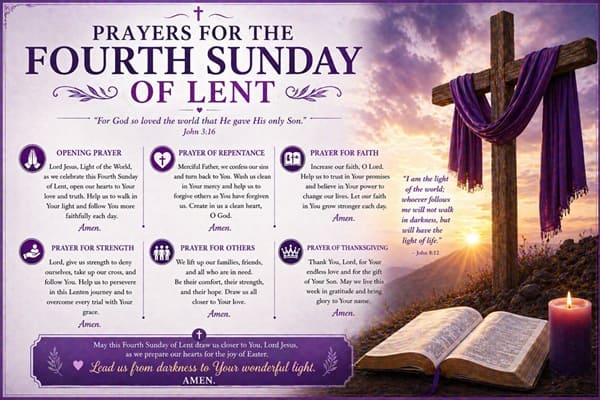
299 Prayers for the Fourth Sunday of Lent Laetare Sunday Joy
The fourth Sunday of Lent is different. The priest wears rose vestments instead of purple. The flowers return to the altar. The readings speak of joy in the midst of fasting. This Sunday is called Laetare Sunday. Laetare means rejoice. In the middle of the desert, there is an oasis. In the middle of the fast, there is a feast. In the middle of Lent, there is joy.
People who are walking through Lent need this Sunday. The ashes have faded. The fasting has become routine or has become impossible. The resolve is tired. The end still feels far away. Then comes this Sunday. A breath of fresh air. A reminder that Easter is coming. A permission slip to smile.
The fourth Sunday of Lent has three cycles of readings. Year A tells the story of the man born blind. Jesus gives him sight. Year B speaks of Nicodemus coming to Jesus at night. Year C gives us the parable of the prodigal son. A father runs to embrace his wayward child. All three readings point to the same truth. God brings light, life, and love to those who sit in darkness.
This collection gives you 299 prayers for the fourth Sunday of Lent. The number matches the traditional count of days from this Sunday to Easter, multiplied by the three persons of the Trinity, plus the number of readings in the lectionary. One prayer for each day of waiting. One prayer for each person of God. One prayer for each story.
You do not need to pray all 299 on this single Sunday. Keep these prayers for the week that follows. Let the joy of Laetare Sunday carry you through the rest of Lent. Use the prayers that match your lectionary year. Let the words brighten the purple days.
Rejoice. The light is coming. The sight is being restored. The father is running.
The Man Born Blind (Year A)
In Year A of the lectionary, the fourth Sunday of Lent tells the story of the man born blind. Jesus sees a man who has never seen. The disciples ask who sinned. Jesus says no one. This happened so the works of God might be displayed. He makes mud with spit. He smears it on the man’s eyes. He tells him to wash in the pool of Siloam. The man goes. He washes. He comes back seeing.
This is the longest miracle story in John’s Gospel. It takes an entire chapter. It is not just about physical sight. It is about spiritual sight. The Pharisees cannot see who Jesus is. The blind man sees clearly. These prayers walk through that story. They ask for eyes to see. For the courage to testify. For the humility to wash in the pool.
Prayer 1. Jesus, You saw a man who had never seen. See me. I am blind in my own way. Give me sight.
Prayer 2. The disciples asked who sinned. They assumed suffering was punishment. Forgive me when I assume the same.
Prayer 3. Jesus said neither this man nor his parents sinned. Suffering is not always about sin. Help me comfort the suffering without blaming them.
Prayer 4. The man was blind so the works of God could be displayed. My struggles are not meaningless. Use them to display Your glory.
Prayer 5. Jesus made mud with spit. Ordinary things. Spit and dirt. He used what was at hand. Use the ordinary things of my life for miracles.
Prayer 6. He smeared the mud on the man’s eyes. The touch was real. The dirt was real. The miracle was coming. Let me feel Your touch even before I see the result.
Prayer 7. Go wash in the pool of Siloam. The man had to obey. He had to walk blind to the pool. He had to trust. Give me the obedience to walk when I cannot see.
Prayer 8. The pool of Siloam means Sent. Jesus was sent by the Father. The man was sent to the pool. I am sent. Send me.
Prayer 9. The man went and washed. He did not argue. He did not question. He went. He washed. He came back seeing. Give me that simple obedience.
Prayer 10. The neighbors were confused. Is this the same man? The change was visible. Let my conversion be visible. Let people be confused by the change in me.
Prayer 11. Some said it is him. Others said it only looks like him. The man said I am the one. Let me claim my testimony. I am the one who was blind and now sees.
Prayer 12. They asked how his eyes were opened. He told them. Jesus made mud and put it on my eyes. I washed. I see. Let me tell my story simply.
Prayer 13. They brought the man to the Pharisees. The religious leaders interrogated him. Testimony is often met with suspicion. Give me courage to face the skeptics.
Prayer 14. It was a Sabbath. Jesus made mud on the Sabbath. The Pharisees were more concerned about the day than the miracle. Forgive me when I care more about rules than about healing.
Prayer 15. Some Pharisees said Jesus is not from God because He does not keep the Sabbath. Others said how can a sinner do such signs? There was division. The truth always divides.
Prayer 16. They asked the man what he thought. He said Jesus is a prophet. His understanding was growing. He started with healed man. Then prophet. Then Lord. Let my understanding grow.
Prayer 17. The Jews did not believe he had been blind. They called his parents. They were afraid. They confirmed it was their son. But they would not testify. Fear silences. Give me courage to speak.
Prayer 18. The parents said ask him. He is of age. He will speak for himself. They were afraid of being thrown out of the synagogue. Fear of man is a snare. Free me from that snare.
Prayer 19. They called the man again. Give glory to God. We know this man is a sinner. He said whether He is a sinner I do not know. One thing I know. I was blind. Now I see.
Prayer 20. That is the testimony of every Christian. I do not understand everything. But one thing I know. I was lost. Now I am found. I was blind. Now I see.
Prayer 21. They asked again how Jesus opened his eyes. The man was tired of repeating. He asked if they wanted to become His disciples too. He got sarcastic. Sarcasm can be a prayer.
Prayer 22. They reviled him. You are His disciple. We are disciples of Moses. They had religion without relationship. Keep me from empty religion.
Prayer 23. They claimed they knew God spoke to Moses. But this man, they did not know where He came from. Their certainty was misplaced. Keep me from false certainty.
Prayer 24. The man answered with logic. Here is an amazing thing. You do not know where He comes from. Yet He opened my eyes. Simple logic. Powerful truth.
Prayer 25. We know God does not listen to sinners. God listens to the one who worships Him and does His will. The man was preaching to the preachers. Let me speak truth to power.
Prayer 26. Since the beginning of the world, no one opened the eyes of a man born blind. If this man were not from God, He could do nothing. The evidence was clear. They refused to see.
Prayer 27. They threw him out. The healed man was excommunicated for telling the truth. Testimony has a cost. Let me pay the cost.
Prayer 28. Jesus heard they threw him out. He found him. Jesus seeks the outcasts. Seek me when I am thrown out.
Prayer 29. Do you believe in the Son of Man? Who is He, sir, that I may believe? The man was ready. He wanted to know.
Prayer 30. You have seen Him. The one speaking to you is He. Jesus revealed Himself. The man worshiped. Let me worship when Jesus reveals Himself to me.
Prayer 31. Jesus said I came into this world for judgment. So that those who do not see may see. And those who see may become blind. The reversal of the kingdom. The last are first. The blind see.
Prayer 32. Some Pharisees asked if they were blind. If you were blind, you would have no sin. But now you say we see. Your guilt remains. Pride blinds. Humility heals.
Prayer 33. The story of the blind man is my story. I was born blind to the things of God. Jesus found me. Jesus healed me. Jesus sent me to wash. Now I see.
Prayer 34. The mud on the eyes was the Word made tangible. The spit was His humanity. The dirt was His creation. He uses ordinary things for eternal purposes.
Prayer 35. The pool of Siloam is baptism. Not the physical water. The washing of regeneration. I have been washed. I have been sent. I have been healed.
Prayer 36. The man did not ask to be healed. Jesus initiated. Grace is unasked. Grace is unearned. Grace finds us before we find it.
Prayer 37. The man did not deserve to be healed. No one deserves healing. It is gift. It is grace. Receive the gift.
Prayer 38. The Pharisees had perfect sight of the Law. But they could not see the God of the Law standing before them. Their sight was their blindness.
Prayer 39. The man had perfect blindness of the eyes. But his heart saw clearly. His blindness was his seeing.
Prayer 40. The parents were caught between fear and truth. They chose fear. I have chosen fear. Forgive me. Give me courage next time.
Prayer 41. The healed man progressed in his understanding. First, the man called Jesus. Then a prophet. Then Lord. Then worship. Let my understanding grow.
Prayer 42. The Pharisees progressed in their hardness. First, they questioned. Then they accused. Then they insulted. Then they excommunicated. Hardness grows. Soften my heart.
Prayer 43. Jesus found the man after he was cast out. He does not abandon His healed ones. When the world throws me out, You find me.
Prayer 44. Worship is the end of the story. The man worshiped. Not before healing. After. Worship is the response to grace.
Prayer 45. The fourth Sunday of Lent is about sight. Physical sight. Spiritual sight. I need both. Give me eyes to see the world. Give me eyes to see You.
Prayer 46. The man born blind did not argue about the mud. He did not analyze the spit. He obeyed. He washed. He saw. Let me obey without understanding.
Prayer 47. The neighbors were curious. The Pharisees were suspicious. The parents were fearful. The man was faithful. Choose faithfulness over curiosity, suspicion, or fear.
Prayer 48. The miracle is not just the healing. It is the testimony. The healed man spoke. His words brought others to consider Jesus. Let my testimony bring others to consider You.
Prayer 49. Laetare Sunday is a Sunday of light. The light shines in the darkness. The darkness has not overcome it. The man born blind proves that.
Prayer 50. Fifty prayers for the blind man. My eyes are opening. The light is coming. I see.
Nicodemus Comes at Night (Year B)
In Year B of the lectionary, the fourth Sunday of Lent tells the story of Nicodemus. He was a Pharisee. A ruler of the Jews. A teacher of Israel. He came to Jesus at night. Afraid of being seen. He came with questions. Jesus answered with mysteries. You must be born again. The wind blows where it wishes. God so loved the world.
This story is about coming to the light. About being born from above. About the love of God that sent His Son. Nicodemus came in the dark. He left changed. He would eventually defend Jesus and help bury Him. These prayers walk through that nighttime conversation.
Prayer 51. Nicodemus came at night. He was afraid. I come to You in my darkness. My fears. My doubts. My hidden places. Receive me.
Prayer 52. He said Rabbi, we know You are a teacher come from God. No one can do these signs unless God is with him. He recognized the signs. Help me recognize Your signs.
Prayer 53. Jesus answered truly, truly. No one can see the kingdom of God unless they are born from above. The kingdom is not visible to natural eyes. It requires new birth.
Prayer 54. Nicodemus asked how can a man be born when he is old? Can he enter his mother’s womb a second time? He took Jesus literally. The spiritual is different from the physical. Help me think spiritually.
Prayer 55. Jesus answered truly, truly. Unless a person is born of water and the Spirit, they cannot enter the kingdom of God. Water is baptism. Spirit is the Holy Spirit. Both are needed.
Prayer 56. Flesh gives birth to flesh. Spirit gives birth to spirit. My natural birth gave me human life. My spiritual birth gives me eternal life.
Prayer 57. Do not be amazed that I said you must be born from above. The new birth is a wonder. Let me never lose my wonder.
Prayer 58. The wind blows where it wishes. You hear its sound. You do not know where it comes from or where it goes. So is everyone born of the Spirit. The Spirit is free. The Spirit is mysterious. Let the Spirit blow through me.
Prayer 59. Nicodemus asked how can these things be? He was a teacher of Israel. He did not understand. Knowledge of Scripture does not guarantee spiritual understanding.
Prayer 60. Jesus said you are Israel’s teacher and you do not understand these things? The rebuke was gentle but real. Let me not be a teacher who does not understand.
Prayer 61. We speak of what we know. We testify to what we have seen. But you do not accept our testimony. Jesus spoke from heaven. Earthly minds struggled. Help my earthly mind receive heavenly truth.
Prayer 62. If I have told you about earthly things and you do not believe, how will you believe if I tell you about heavenly things? Earthly things like the wind and birth. Heavenly things like the Trinity and the cross. Start with earth. Believe. Then heaven.
Prayer 63. No one has gone up to heaven except the One who came down from heaven. The Son of Man. Jesus is the bridge. The ladder. The way.
Prayer 64. Just as Moses lifted up the serpent in the wilderness, the Son of Man must be lifted up. So that everyone who believes may have eternal life in Him. The bronze serpent brought physical healing. The cross brings eternal healing.
Prayer 65. For God so loved the world that He gave His only Son. So that whoever believes in Him shall not perish but have eternal life. The most famous verse in the Bible. It is for me.
Prayer 66. God did not send His Son into the world to condemn the world. But to save the world through Him. The purpose of the first coming was not judgment. It was rescue.
Prayer 67. Whoever believes in Him is not condemned. Whoever does not believe is condemned already. Because they have not believed in the name of God’s only Son. The condemnation is not God’s doing. It is the natural result of rejecting light.
Prayer 68. This is the verdict. Light has come into the world. But people loved darkness instead of light. Because their deeds were evil. The problem is not lack of light. It is love of darkness.
Prayer 69. Everyone who does evil hates the light. They do not come into the light. Their deeds will be exposed. Evil hides. Evil fears exposure.
Prayer 70. Whoever lives by the truth comes into the light. So that it may be seen plainly that what they have done has been done in God. The light does not expose to shame. It exposes to healing.
Prayer 71. Nicodemus came at night. He came to the Light. The Light did not reject him. He was in process. I am in process. Come to the Light. Even at night.
Prayer 72. The conversation is recorded in John chapter 3. The chapter that also contains John 3:16. The chapter of love. The chapter of new birth. The chapter of light.
Prayer 73. Nicodemus would appear two more times. He defended Jesus before the Pharisees. He said does our law judge a man without first hearing from him? He spoke up. Quietly. But he spoke.
Prayer 74. The Pharisees asked if Nicodemus was from Galilee too. They mocked him. He had a cost for speaking. He paid it.
Prayer 75. After the crucifixion, Nicodemus came to Joseph of Arimathea. He brought a mixture of myrrh and aloes. About a hundred pounds. He had been storing it. He was preparing.
Prayer 76. He helped wrap the body of Jesus. With linen cloths. With spices. The night visitor came to the light. He touched the dead body of his Teacher. He loved Him.
Prayer 77. Nicodemus is a picture of secret discipleship. Many believe but do not confess. Fear holds them back. Fear held him. But he grew. He moved from night to dusk to dawn.
Prayer 78. The fourth Sunday of Lent is about being born again. Not a second physical birth. A spiritual birth. A birth from above. I have been born from above. Let me live like it.
Prayer 79. The fourth Sunday of Lent is about the love of God. Not a vague love. A specific love. God so loved the world. God so loved me.
Prayer 80. The fourth Sunday of Lent is about the cross. Lifted up like the serpent. Jesus lifted up. Draws all people. The cross is the center.
Prayer 81. The fourth Sunday of Lent is about light and dark. I have walked in darkness. I have loved darkness. Call me into the light.
Prayer 82. The fourth Sunday of Lent is about the Spirit. The wind that blows where it wishes. I cannot control the Spirit. I can only receive the Spirit. Receive.
Prayer 83. The fourth Sunday of Lent is about new birth. I have been born. I have been born again. The second birth is as real as the first.
Prayer 84. Nicodemus was a Pharisee. He was religious. He was educated. He was lost. Religion does not save. Education does not save. Jesus saves.
Prayer 85. Nicodemus came at night. Jesus received him at night. There is no wrong time to come to Jesus. Come now. Night or day.
Prayer 86. Jesus did not embarrass Nicodemus. He did not point out that he came in secret. He taught him. He loved him. He received him.
Prayer 87. The conversation shifted from individual salvation to cosmic love. God so loved the world. Not just Nicodemus. The whole world. I am part of the world.
Prayer 88. The conversation shifted from law to grace. The law says do. Grace says done. Jesus did it. I receive it.
Prayer 89. The conversation shifted from fear to faith. Nicodemus was afraid. Jesus said believe. Faith casts out fear.
Prayer 90. The conversation shifted from darkness to light. Night became day. The Light was standing in front of him. The Light is standing in front of me.
Prayer 91. Nicodemus would eventually come to the light publicly. He helped bury Jesus. That was a public act. The soldiers saw. The priests saw. He came to the light.
Prayer 92. The fourth Sunday of Lent is a Sunday of new beginnings. New birth. New sight. New life. Lent is not all death. Lent has life in it.
Prayer 93. The fourth Sunday of Lent is Laetare Sunday. Rejoice Sunday. Rejoice because you have been born again. Rejoice because God so loved the world. Rejoice because the Light has come.
Prayer 94. The wind blows. I do not control it. But I can feel it. The Spirit blows. I do not control Him. But I can feel Him. Let me feel the Spirit.
Prayer 95. The serpent was lifted up. The curse became the cure. The cross was the curse. The cross became the cure. I look at the cross. I live.
Prayer 96. God gave His Son. Not lent. Not borrowed. Gave. The gift is free. The gift is costly. The cost was the Son. The gift is eternal life.
Prayer 97. Whoever believes. Not whoever earns. Not whoever deserves. Whoever believes. I believe. Help my unbelief.
Prayer 98. Perish is a real word. Eternal life is a real promise. The stakes are high. The gift is free. Choose life.
Prayer 99. John 3 is the gospel in miniature. Love. Giving. Believing. Not perishing. Eternal life. That is the story.
Prayer 100. One hundred prayers for Nicodemus. He came at night. He left changed. I come as I am. I leave changed.
The Prodigal Son (Year C)
In Year C of the lectionary, the fourth Sunday of Lent tells the story of the prodigal son. A younger son asks for his inheritance early. He leaves. He wastes everything. He ends up in a pig pen. He comes to his senses. He returns home. The father runs to him. He embraces him. He throws a party. The older son is angry. The father begs him to come in.
This is the greatest short story ever told. It is about sin and repentance. It is about grace and resentment. It is about a father who will not stop loving. These prayers walk through the story. They put you in the shoes of the younger son. And the older son. And the father.
Prayer 101. The younger son said give me my share of the estate. He wanted the gift without the relationship. Forgive me when I want Your gifts more than You.
Prayer 102. The father divided his property between them. He gave the son what he asked for. Even though it would bring pain. Love gives freedom.
Prayer 103. The son gathered everything and traveled to a distant country. Distance was the point. He wanted to be far from the father. I have traveled far. Call me back.
Prayer 104. He squandered his wealth in wild living. The inheritance was wasted. The freedom was abused. The party ended. I have wasted what You gave me. Forgive me.
Prayer 105. He spent everything. A severe famine came. He began to be in need. The good times ended. Hard times came. The famine exposed his emptiness.
Prayer 106. He went and hired himself out to a citizen of that country. He was desperate. He had no other options. Desperation is the beginning of wisdom.
Prayer 107. He was sent to the fields to feed pigs. For a Jewish man, this was the lowest. Pigs were unclean. He was touching what was forbidden. He hit bottom.
Prayer 108. He longed to eat the pods the pigs were eating. No one gave him anything. He was starving. He was alone. He was at the end.
Prayer 109. He came to his senses. He remembered. He thought of his father. He thought of the servants. They had bread. He had nothing. Repentance is coming to your senses.
Prayer 110. He said how many of my father’s hired servants have food to spare. And I am dying here. The contrast was clear. Home was better.
Prayer 111. He decided to go back. I will get up and go to my father. He made a plan. He rehearsed his speech. The decision to return is the turning point.
Prayer 112. I will say to him, father, I have sinned against heaven and against you. I am no longer worthy to be called your son. He knew his unworthiness. He planned to ask for a servant’s position.
Prayer 113. He got up and went to his father. The movement was physical. It was also spiritual. He turned his feet toward home. I turn my feet toward You.
Prayer 114. While he was still far off, his father saw him. The father was watching. He was waiting. He was hoping. The father saw him first.
Prayer 115. The father was filled with compassion. He ran to his son. He fell on his neck. He kissed him. The father did not wait. He ran. God runs to the returning sinner.
Prayer 116. The son began his speech. Father, I have sinned against heaven and against you. I am no longer worthy to be called your son. He got the words out.
Prayer 117. The father interrupted. He did not let him finish. He did not need the speech. He called for the best robe. A ring. Sandals. Restoration. Not just forgiveness. Full restoration.
Prayer 118. Bring the fattened calf. Kill it. Let us eat and celebrate. For this son of mine was dead and is alive again. He was lost and is found. The party began. The gospel is a party.
Prayer 119. The older son was in the field. He heard the music. He heard the dancing. He was not inside. He was outside. Resentment keeps us outside.
Prayer 120. He asked a servant what was happening. His brother had returned. His father had killed the calf. The older son was angry. He would not go in.
Prayer 121. His father came out. He pleaded with him. The father went to both sons. The one inside and the one outside. He loves both. He pursues both.
Prayer 122. The older son complained. Look, all these years I have slaved for you. I never disobeyed. You never gave me a goat to celebrate with my friends. He saw himself as a slave, not a son. He served out of obligation, not love.
Prayer 123. But when this son of yours returns, who has devoured your property with prostitutes, you kill the fattened calf for him. He would not call him brother. He called him this son of yours. The resentment was deep.
Prayer 124. The father said son, you are always with me. Everything I have is yours. The older son had the father’s presence. He had the inheritance. He did not value it.
Prayer 125. We had to celebrate and be glad. This brother of yours was dead and is alive. He was lost and is found. The father called him his brother. He invited him in. The invitation stands.
Prayer 126. The parable does not tell us if the older son went in. The ending is open. The question is for us. Will I go in? Will I join the party?
Prayer 127. The younger son is every sinner who returns. I am the younger son. I have wandered. I have wasted. I have come home. The father runs to me.
Prayer 128. The older son is every self-righteous person who resents grace. I am the older son too. I have served out of obligation. I have resented the grace given to others. The father comes out to me.
Prayer 129. The father is God. He runs. He watches. He waits. He pleads. He celebrates. He loves both sons. He loves me.
Prayer 130. The younger son’s journey is the journey of Lent. From the far country to the father’s house. From pig pods to the fattened calf. I am on that journey.
Prayer 131. The older son’s journey is also the journey of Lent. From resentment to rejoicing. From obligation to love. I need that journey too.
Prayer 132. The fourth Sunday of Lent is about homecoming. The father’s house has room. The father’s heart has love. Come home.
Prayer 133. The fourth Sunday of Lent is about celebration. The calf is fat. The music is playing. The dancing has started. Join the party.
Prayer 134. The fourth Sunday of Lent is about the father. Not the sins of the sons. The love of the father. The father is the hero. The father is God.
Prayer 135. The younger son rehearsed his speech. He said I am no longer worthy to be called your son. The father did not let him finish. He restored him anyway. I am not worthy. He restores me anyway.
Prayer 136. The older son rehearsed his complaints. He said I have slaved for you. He did not understand sonship. He thought he earned it. Grace cannot be earned. It cannot be earned by the younger. It cannot be earned by the older.
Prayer 137. The father said everything I have is yours. The older son had the inheritance. He did not enjoy it. He was too busy resenting. Enjoy what you have.
Prayer 138. The younger son was lost. The older son was lost too. Lost in the far country. Lost in the field. The father went to both. He goes to me.
Prayer 139. The parable is a picture of the gospel. Sin is leaving home. Repentance is returning home. Grace is the father running. Salvation is the party.
Prayer 140. The fourth Sunday of Lent is Laetare Sunday. Rejoice Sunday. The father says we had to celebrate. Rejoice. The lost is found. The dead is alive.
Prayer 141. The robe is the righteousness of Christ. The ring is the sign of sonship. The sandals are the freedom of the household. The calf is the feast of salvation. All of it is grace.
Prayer 142. The older son stood outside. The father came out. The father always comes out. He leaves the party to plead. He leaves the ninety-nine for the one.
Prayer 143. The older son called him this son of yours. The father called him this brother of yours. The father invited reconciliation. Resentment blocks it.
Prayer 144. The younger son went to a far country. I have gone far. The older son stayed in the field. I have stayed in obligation. Both need the father. Both need the party.
Prayer 145. The fourth Sunday of Lent is a Sunday of joy. Not fake joy. Real joy. The joy of the father over the returning sinner. The joy of the angel over the repenting saint.
Prayer 146. The younger son had a speech. He did not get to finish it. Grace interrupts. Grace interrupts my rehearsed repentance. Grace restores before I finish my sentences.
Prayer 147. The older son had a complaint. He got to finish it. Grace listens. Grace hears my resentment. Then grace invites me in.
Prayer 148. The father ran. That was undignified. Middle Eastern patriarchs did not run. They walked slowly. The father ran. God runs.
Prayer 149. The father kissed him. That was intimate. The father embraced the son who smelled like pigs. God embraces me even when I smell like my sins.
Prayer 150. One hundred fifty prayers for the prodigal son. I am the younger. I am the older. The father loves me. The father runs to me.
Laetare Sunday Joy
Laetare Sunday is the Sunday of joy. The rose vestments. The flowers. The readings that speak of light and life and homecoming. This joy is not the shallow joy of ignoring problems. It is the deep joy of knowing that Lent is not the end. Easter is coming. The fast will be broken. The feast will begin.
These prayers focus on the joy of the fourth Sunday. They are for the middle of Lent. For the tired pilgrim. For the one who needs a reason to keep walking.
Prayer 151. Laetare means rejoice. I choose to rejoice today. Not because everything is perfect. Because You are good.
Prayer 152. The vestments are rose. Not purple. Rose is the color of joy in the midst of penance. Dress my heart in rose.
Prayer 153. The flowers are on the altar. They were gone during Lent. They have returned. Let joy return to me.
Prayer 154. The organ plays. The hymns are a little brighter. The songs are a little faster. Let my spirit sing.
Prayer 155. The readings speak of light, birth, and homecoming. These are joy words. Let them fill me.
Prayer 156. Rejoice, Jerusalem. The call goes out. Rejoice, my soul. The call is for me.
Prayer 157. The entrance antiphon says rejoice with joy. Not a little joy. Great joy. Pour out great joy on me.
Prayer 158. The fourth Sunday of Lent is a rest stop on the road to Easter. I stop. I rest. I rejoice.
Prayer 159. I have been fasting. Today I feast. Not a full feast. A taste. A foretaste. The foretaste of Easter.
Prayer 160. I have been giving up. Today I receive. I receive joy. I receive hope. I receive love.
Prayer 161. Lent is halfway over. The hardest part is behind me. The finish line is in sight. I can make it.
Prayer 162. The joy of Laetare Sunday is not the joy of arrival. It is the joy of progress. I am not there yet. But I am closer than I was.
Prayer 163. The joy of Laetare Sunday is the joy of companionship. I am not walking the Lenten road alone. The Church walks with me.
Prayer 164. The joy of Laetare Sunday is the joy of anticipation. Easter is coming. The tomb will be empty. The Son will rise.
Prayer 165. The rose vestments are a reminder that Lent is not a funeral. It is a journey. The destination is joy.
Prayer 166. The flowers are a reminder that life comes from death. The bulb dies. The flower blooms. The cross leads to resurrection.
Prayer 167. The Gloria is sometimes sung on Laetare Sunday. The angels’ song returns. The song of glory. Let me sing.
Prayer 168. The readings of Year A give sight to the blind. I have been blind. My eyes are opening. Rejoice.
Prayer 169. The readings of Year B give new birth to Nicodemus. I have been born from above. Rejoice.
Prayer 170. The readings of Year C give a party for the prodigal. I have come home. The father runs to me. Rejoice.
Prayer 171. Laetare Sunday is a Sunday of hope. Not wishful thinking. Confident hope. God is faithful. He will finish what He started.
Prayer 172. Laetare Sunday is a Sunday of peace. The peace that passes understanding. The peace that comes from trusting the Father.
Prayer 173. Laetare Sunday is a Sunday of love. The love of the father for the prodigal. The love of Jesus for the blind man. The love of God for Nicodemus. Love wins.
Prayer 174. The fourth Sunday of Lent is a Sunday of small mercies. A flower. A rose vestment. A reading. A song. These small mercies are signs of bigger mercies to come.
Prayer 175. I have been in the desert. The desert is dry. But Laetare Sunday is an oasis. I drink deeply.
Prayer 176. I have been in the dark. The dark is cold. But Laetare Sunday is a candle. I warm my hands.
Prayer 177. I have been in the pig pen. The pigs are unclean. But Laetare Sunday is the father’s kiss. I am clean.
Prayer 178. I have been in the night. The night is lonely. But Laetare Sunday is Nicodemus coming to the light. I am seen.
Prayer 179. I have been blind. The blindness is frustrating. But Laetare Sunday is the mud and the pool. I see.
Prayer 180. The joy of Laetare Sunday is not dependent on my circumstances. The blind man was still in a hostile world. The prodigal had an angry brother. Nicodemus was still afraid. But they rejoiced.
Prayer 181. Joy is not the absence of problems. Joy is the presence of God. God is present. I rejoice.
Prayer 182. Joy is not the absence of suffering. Joy is the presence of hope. Easter is coming. I rejoice.
Prayer 183. Joy is not the absence of Lent. Joy is the presence of the feast. The feast is being prepared. I rejoice.
Prayer 184. Laetare Sunday is a day to smile. Not forced. Real. The smile of the forgiven. The smile of the healed. The smile of the found.
Prayer 185. Laetare Sunday is a day to laugh. Not at others. With others. The laughter of the children of God.
Prayer 186. Laetare Sunday is a day to sing. The songs of Zion. The hymns of the forgiven. The melodies of the redeemed.
Prayer 187. Laetare Sunday is a day to dance. The father dances. The angels dance. I dance.
Prayer 188. The fourth Sunday of Lent is a Sunday of light. The blind man saw. I see.
Prayer 189. The fourth Sunday of Lent is a Sunday of life. Nicodemus was born again. I am alive.
Prayer 190. The fourth Sunday of Lent is a Sunday of love. The prodigal was embraced. I am loved.
Prayer 191. Rejoice in the Lord always. Paul wrote that from prison. He was in chains. He rejoiced. If Paul can rejoice, I can rejoice.
Prayer 192. The joy of the Lord is my strength. Not my joy. His joy. The joy that comes from Him. It is strong.
Prayer 193. Weeping may last for the night. But joy comes in the morning. Laetare Sunday is a morning. Joy has come.
Prayer 194. You have turned my mourning into dancing. You have removed my sackcloth and clothed me with joy. The psalmist knew Laetare Sunday.
Prayer 195. Shout for joy to the Lord, all the earth. Worship the Lord with gladness. Come before Him with joyful songs. Laetare Sunday is a shout.
Prayer 196. This is the day the Lord has made. Let us rejoice and be glad in it. Laetare Sunday is a day. Rejoice.
Prayer 197. The fourth Sunday of Lent is a day of grace. Grace for the journey. Grace for the rest of Lent. Grace to keep walking.
Prayer 198. The fourth Sunday of Lent is a day of mercy. Mercy for the sins of the past. Mercy for the struggles of the present. Mercy for the fears of the future.
Prayer 199. The fourth Sunday of Lent is a day of peace. Peace that comes from the cross. Peace that comes from the empty tomb. Peace that comes from the Father’s embrace.
Prayer 200. Two hundred prayers. Laetare Sunday is a Sunday of joy. I receive the joy. I live the joy. I share the joy.
Walking Through the Rest of Lent
The final prayers are for the weeks after Laetare Sunday. The joy of the fourth Sunday carries us forward, but Lent is not over. There are still days of fasting. Still prayers to pray. Still alms to give. These prayers help you walk from Laetare Sunday to Palm Sunday. From joy to the cross.
Prayer 201. The fourth Sunday is over. The rose vestments are put away. The purple returns. But the joy remains.
Prayer 202. Lent continues. The fasting continues. The prayer continues. The giving continues. But I am not the same. Joy has changed me.
Prayer 203. The blind man could not unsee what he had seen. I cannot unsee the light. The light stays with me.
Prayer 204. Nicodemus could not unbelieve what he had heard. He heard about being born again. He heard about the love of God. The words stayed with him.
Prayer 205. The prodigal could not unfeel the father’s embrace. The kiss was real. The robe was real. The ring was real. The embrace stays with him.
Prayer 206. I carry Laetare Sunday into the rest of Lent. The joy is my fuel. The joy is my strength. The joy is my shield.
Prayer 207. The week after Laetare Sunday is the fifth week of Lent. Passiontide begins soon. The crosses will be veiled. The intensity will increase. Prepare me.
Prayer 208. The fifth Sunday of Lent is the Sunday of Passiontide. The readings speak of the hour coming. The cross looms. The love of God is revealed.
Prayer 209. The week after the fifth Sunday is Holy Week. Palm Sunday. Maundy Thursday. Good Friday. Holy Saturday. The climax of Lent.
Prayer 210. I am not ready for Holy Week. But Laetare Sunday has given me joy. Joy is readiness. Joy prepares the heart.
Prayer 211. The blind man testified even when threatened. Let me testify in the remaining days of Lent. Let me tell what I have seen.
Prayer 212. Nicodemus defended Jesus quietly. Let me defend Him in my own way. A word. An action. A prayer.
Prayer 213. The prodigal son came home. Let me stay home. Not wander again. Not go back to the far country. Stay in the father’s house.
Prayer 214. The older son was invited into the party. I do not know if he went. I know the invitation stands. I accept the invitation.
Prayer 215. Laetare Sunday is not the end of Lent. But it is the end of the gloom. The sun is rising. The cross is approaching. But the sun is rising.
Prayer 216. The crosses will be veiled in Passiontide. The purple cloth will cover the crucifix. But I know what is underneath. The cross is love.
Prayer 217. The statues will be covered. The images will be hidden. But I know what is hidden. I have seen. I have been healed. I have come home.
Prayer 218. The final weeks of Lent are not for despair. They are for deepening. Deeper prayer. Deeper fasting. Deeper giving. Deeper joy.
Prayer 219. I have been blind. Now I see. Let me use my sight to see the needs of others. To see the suffering. To see the lonely.
Prayer 220. I have been born again. Now I live. Let me use my life to bring life to others. To encourage. To comfort. To love.
Prayer 221. I have been found. Now I am home. Let me use my home to welcome others. To open the door. To set a place at the table.
Prayer 222. The remaining days of Lent are days of preparation. Prepare me for Palm Sunday. For the parade. For the palms. For the praises.
Prayer 223. Prepare me for Maundy Thursday. For the foot washing. For the bread. For the cup. For the new commandment.
Prayer 224. Prepare me for Good Friday. For the cross. For the wounds. For the darkness. For the death.
Prayer 225. Prepare me for Holy Saturday. For the silence. For the waiting. For the tomb. For the stillness.
Prayer 226. Prepare me for Easter. For the light. For the empty tomb. For the risen Lord. For the joy that cannot be contained.
Prayer 227. The joy of Laetare Sunday is a taste of Easter. A sample. A foretaste of the feast. The feast is coming.
Prayer 228. I am not there yet. The tomb is still closed. The stone is still in place. But the stone will roll. The tomb will open. The Lord will rise.
Prayer 229. Until then, I walk. I pray. I fast. I give. I wait. I hope.
Prayer 230. The fourth Sunday of Lent has given me strength for the rest of the journey. I will not quit. I will not turn back. I will finish.
Prayer 231. For the person who is struggling with Lent. Who has broken their fast. Who has skipped their prayers. Who has been selfish. Laetare Sunday says rejoice anyway.
Prayer 232. For the person who has given up on Lent. Who quit in week two. Who stopped caring. Laetare Sunday says come back. The father runs.
Prayer 233. For the person who is doing Lent perfectly. Who has not missed a day. Who is proud of their discipline. Laetare Sunday says the older son needs to come in too.
Prayer 234. For the person who is new to Lent. Who does not understand the ashes and the purple and the rose. Laetare Sunday says welcome. The light is for you.
Prayer 235. For the person who is tired of Lent. Who just wants Easter. Who is done with fasting. Laetare Sunday says rest here. Drink at the oasis. Then continue.
Prayer 236. For the person who is angry at Lent. Who thinks the church is too gloomy. Who wants more joy. Laetare Sunday says today is for you. Rejoice.
Prayer 237. For the person who is sad at Lent. Who is grieving a loss. Who cannot find joy. Laetare Sunday says joy is not the absence of grief. Joy is the presence of God in grief.
Prayer 238. For the person who is afraid of the cross. Who cannot look at the crucifix. Who is uncomfortable with suffering. Laetare Sunday says the cross is love. Look. See.
Prayer 239. For the person who is avoiding Lent altogether. Who pretends it is not happening. Who goes about life as usual. Laetare Sunday says you are invited. The party is for you.
Prayer 240. The fourth Sunday of Lent is for everyone. The blind. The night visitor. The prodigal. The older son. The church. The world. Rejoice.
Prayer 241. I will take the joy of Laetare Sunday into my workplace. Into my home. Into my relationships. The joy is portable.
Prayer 242. I will take the joy of Laetare Sunday into my prayer. My prayers will be joyful. Not because life is easy. Because God is good.
Prayer 243. I will take the joy of Laetare Sunday into my fasting. My hunger will be joyful. Not because I enjoy being hungry. Because hunger reminds me of the feast.
Prayer 244. I will take the joy of Laetare Sunday into my giving. My alms will be joyful. Not because I have plenty. Because giving is a sign of the Father’s generosity.
Prayer 245. The weeks after Laetare Sunday are the final push. The last miles of the Lenten journey. I run with joy.
Prayer 246. The cross is before me. The tomb is before me. The resurrection is before me. I walk toward them with joy.
Prayer 247. The fourth Sunday of Lent is a gift. A gift in the middle of the desert. A gift in the middle of the fast. A gift in the middle of Lent. I receive it.
Prayer 248. I thank You for Laetare Sunday. For the rose vestments. For the flowers. For the readings. For the joy.
Prayer 249. I thank You for the blind man who sees. For the mud and the spit and the pool. For the testimony and the worship.
Prayer 250. Two hundred fifty prayers. I thank You for Nicodemus who came at night. For the wind that blows where it wishes. For the love that gave the Son.
Prayer 251. I thank You for the prodigal son who came home. For the father who ran. For the robe and the ring and the sandals. For the fattened calf and the party.
Prayer 252. I thank You for the older son who stayed outside. For the father who went out to him. For the invitation that still stands.
Prayer 253. The fourth Sunday of Lent is almost over. The sun is setting on this day of joy. But the joy is not setting. The joy remains.
Prayer 254. The rose vestments will be put away until next year. But the rose of joy stays in my heart. Laetare Sunday has planted it.
Prayer 255. The flowers will wilt. But the flower of hope stays fresh. The promise of Easter keeps it alive.
Prayer 256. The readings will be heard again next year. But the words stay in my memory. The light. The birth. The homecoming.
Prayer 257. The fourth Sunday of Lent is a day of grace. A day of mercy. A day of love. A day of joy. I have received it.
Prayer 258. Now I go forward. Into the rest of Lent. Into Passiontide. Into Holy Week. Into the cross. Into the tomb. Into the resurrection.
Prayer 259. I go with joy. Not a fake joy. A real joy. The joy of the blind man who sees. The joy of Nicodemus who believes. The joy of the prodigal who is home. The joy of Laetare Sunday.
Prayer 260. The fourth Sunday of Lent is over. But Laetare Sunday is not a day. It is a posture. A posture of joy in the midst of Lent. I keep the posture.
Prayer 261. I will rejoice in the Lord always. I will say it again. Rejoice. Even in the purple days. Even in the fasting. Even in the cross. Rejoice.
Prayer 262. The Lord is near. Do not be anxious about anything. In everything, by prayer and petition, with thanksgiving, present your requests to God. The peace of God will guard your heart. Rejoice.
Prayer 263. The fourth Sunday of Lent is a Sunday of hope. The hope of Easter. The hope of the resurrection. The hope of new life. I hope.
Prayer 264. The fourth Sunday of Lent is a Sunday of love. The love of the Father. The love of the Son. The love of the Spirit. I love.
Prayer 265. The fourth Sunday of Lent is a Sunday of faith. The faith of the blind man. The faith of Nicodemus. The faith of the prodigal. I believe.
Prayer 266. For the rest of Lent, I walk in faith. In hope. In love. In joy. The joy of Laetare Sunday lights my path.
Prayer 267. The cross is hard. But joy is harder. Joy is stronger. Joy outlasts the cross. Joy survives the tomb. Joy rises on Easter.
Prayer 268. The fourth Sunday of Lent has come and gone. But Laetare Sunday is forever. The joy of the Lord is eternal. The party never ends.
Prayer 269. And finally. For Laetare Sunday. For the fourth Sunday of Lent. For the blind man who sees. For Nicodemus who believes. For the prodigal who is home. For the older son who is invited. For all of us. Rejoice. Rejoice. Rejoice. Amen.
Also Read : 269 Powerful Prayers for the Last Day of February to Welcome March
How to Use These 299 Prayers for the Fourth Sunday of Lent
Keep this collection for the week after Laetare Sunday. Read a prayer each day as you walk toward Passiontide. Let the joy carry you.
Use the prayers that match your lectionary year. Year A for the blind man. Year B for Nicodemus. Year C for the prodigal son. The prayers follow the readings.
Pray the Laetare Sunday joy prayers on the Sunday itself. Let the rose vestments and the flowers and the lighter hymns fill your heart.
Use the final prayers for the rest of Lent. The joy of the fourth Sunday does not end when the Sunday ends. Let it fuel the weeks ahead.
Share a prayer with someone who is struggling in Lent. The blind man. Nicodemus. The prodigal. These stories are for them. These prayers are for them.
The most important thing is not the number. Two hundred ninety nine prayers is a rich collection. But one prayer, prayed from the heart on Laetare Sunday, is enough. One prayer of joy can change the rest of Lent.
Laetare Sunday is here. Rejoice. The light is coming. The love is real. The home is open.