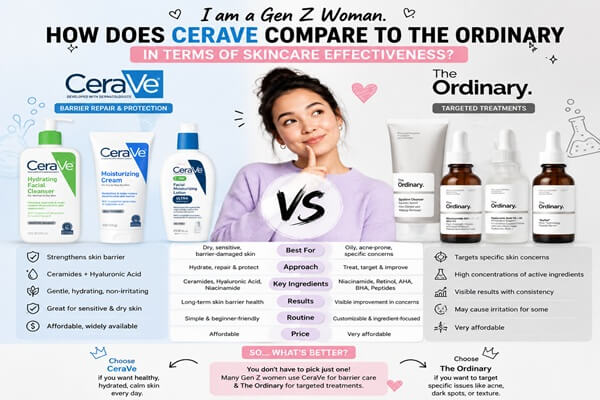
i am a genz woman. how does cerave compare to the ordinary in terms of skincare effectiveness?
| They’re not really competing for the same job. CeraVe is your barrier-repair and daily-essentials brand, cleansers, moisturizers, sunscreen, built around ceramides. The Ordinary is your targeted-active brand, single-ingredient serums like niacinamide, vitamin C, and retinol at accessible prices. For pure effectiveness, CeraVe wins for calming and hydrating compromised skin, while The Ordinary wins for solving a specific concern like dullness, texture, or breakouts. Most skincare pros will tell you the actual best routine uses both. |
If your For You Page has shown you even ten skincare videos, you’ve seen these two names fighting for the same five seconds of screen time. CeraVe with its Michael-Cera-adjacent internet jokes and the tub of Moisturizing Cream everyone’s mom also somehow owns. The Ordinary with its clinical, no-frills bottles that look like they belong in a chemistry lab, at prices that make it feel like you’re getting away with something. Both have massive, genuine fanbases. Both get recommended by actual dermatologists on TikTok, not just influencers. So which one actually works better?
Short answer: that’s the wrong question. These two brands were built to do different jobs, and comparing them head-to-head as if they’re interchangeable is like asking whether a hammer is better than a screwdriver. Once you understand what each one is actually for, the effectiveness question answers itself, and you’ll probably end up wanting both in your bathroom instead of picking a side, which is exactly what most skincare-savvy people who’ve tried both eventually land on.
Two Completely Different Origin Stories
CeraVe launched in 2005, developed with input from dermatologists from the start, and built its entire identity around three specific ceramides, essential lipids that make up a huge chunk of your skin’s natural barrier, delivered through a patented slow-release technology called MVE. The brand’s pitch has never been about flashy actives. It’s about restoring and protecting the barrier that keeps your skin from losing moisture and reacting to everything around it. That focus has paid off in a very concrete way: CeraVe has received more seals of acceptance from the National Eczema Association than any other skincare brand, which says a lot about how seriously dermatologists take its barrier-focused formulas.
The Ordinary, part of the DECIEM family, launched in 2016 with a completely different mission: strip away the markup and mystery around active ingredients and sell them at close to production cost. Instead of one all-purpose cream, The Ordinary sells dozens of specific, often single-ingredient serums, straight niacinamide, straight vitamin C, straight retinol, so you can build a routine targeted at your exact concern instead of paying for a jack-of-all-trades formula. It’s less a skincare brand in the traditional sense and more a supply chain for actives that used to only show up in much more expensive products.
What Each Brand Is Actually Best At
| Category | CeraVe | The Ordinary |
| Core focus | Barrier repair and daily hydration | Targeted active treatment serums |
| Signature ingredient | Three ceramides + hyaluronic acid, MVE delivery tech | Niacinamide, vitamin C, retinol, AHA/BHA exfoliants |
| Best product category | Cleansers, moisturizers, sunscreen | Serums and treatments |
| Texture and complexity | Multi-ingredient, ready-to-use formulas | Often single-ingredient, more DIY-routine-building |
| Best for | Dry, sensitive, reactive, or compromised skin | Dullness, uneven tone, texture, oil control, fine lines |
| Learning curve | Very low, hard to misuse | Moderate, requires understanding what you’re layering |
| Price range | Budget, roughly consistent across the line | Extremely budget, some of the cheapest actives available anywhere |
The Ingredient Science, Explained Simply
CeraVe’s whole formula philosophy rests on ceramides, which are lipids, basically fats, that sit between your skin cells and hold your barrier together, the same way mortar holds bricks together. When that barrier is compromised, from over-exfoliating, harsh weather, stress, or just genetics, water escapes faster and irritants get in more easily. CeraVe’s three-ceramide blend, paired with hyaluronic acid for hydration, is specifically designed to replace what your skin barrier is missing, not just sit on top of it.
The Ordinary’s approach is built around delivering research-backed active ingredients at meaningful concentrations without excessive markup. Niacinamide, one of its most popular products, has real evidence behind it for reducing oiliness, calming inflammation, and improving the appearance of pores. Here’s a myth worth busting though: higher concentration does not automatically mean better results. Most actives, niacinamide included, show strong effectiveness in the 4 to 5 percent range, and pushing to 10 percent or higher mainly increases your risk of irritation without necessarily improving results. The Ordinary’s Niacinamide 10% + Zinc 1% is genuinely effective, but it’s not automatically superior to a gentler concentration just because the number on the label is bigger.
Round One: Cleansers
This isn’t close. CeraVe makes cleansers as a core part of its lineup, formulated to clean without stripping your barrier, while The Ordinary barely touches this category. If you’re building a full routine and need a cleanser, CeraVe is the obvious pick here, no real competition.
Round Two: Moisturizers
Same story. CeraVe’s Moisturizing Cream and Facial Moisturizing Lotion are genuinely some of the most recommended, dermatologist-endorsed moisturizers in the entire drugstore category, largely because of that ceramide-plus-hyaluronic-acid combination working exactly as intended. The Ordinary has a couple of simple moisturizers, like its Natural Moisturizing Factors formula, but moisturizing has never been the brand’s main focus, and it shows.
Round Three: Active Treatment Serums
This is where The Ordinary takes over completely. Want a straightforward, effective niacinamide serum for oil control and pores? A salicylic acid solution for congestion? A suspension-form vitamin C for brightening? The Ordinary has a specific, affordable answer for almost every individual skin concern, letting you build exactly the routine you need rather than settling for whatever active happens to be included in a CeraVe multi-ingredient formula.
Round Four: Beginner-Friendliness
CeraVe wins outright here. Its products are genuinely hard to misuse, gentle enough for daily use, and formulated to work well together right out of the box, which matters a lot if you’re new to skincare and don’t want to accidentally overload your face. The Ordinary requires more knowledge: knowing which actives to combine, which to avoid layering together, and how to introduce them gradually. It’s an incredible brand once you know what you’re doing, and a little overwhelming if you don’t.
Best Beginner Picks If You’re Trying The Ordinary
- Niacinamide 10% + Zinc 1%: low irritation risk, solid all-around pick for oiliness and pores.
- Hyaluronic Acid 2% + B5: straightforward hydration that layers well under anything.
- Natural Moisturizing Factors + HA: a simple, no-frills moisturizer if you want to stay within one brand.
- Hold off on the AHA/BHA peeling solution and high-strength vitamin C suspension until you know how your skin reacts to actives in general.
Can You Actually Combine Them? (Yes, and It’s the Smart Move)
The skincare community keeps landing on the same answer for a reason: use CeraVe as your structural foundation, cleanser, moisturizer, sunscreen, and layer The Ordinary’s targeted actives on top to handle specific concerns. This isn’t a cop-out answer, it’s genuinely how a lot of dermatologists recommend building an effective, affordable routine. CeraVe keeps your barrier calm and hydrated while The Ordinary’s serums do the more targeted work, brightening, oil control, anti-aging, that a basic moisturizer alone was never going to accomplish.
A simple version of this combined routine: cleanse with a CeraVe cleanser, apply a Ordinary serum suited to your main concern, then seal everything in with a CeraVe moisturizer, finishing with sunscreen in the morning. That structure gives you barrier support at both ends of the routine with a targeted treatment doing the heavy lifting in the middle.
Step-by-Step: A Simple Combined Routine
- Cleanse with a CeraVe cleanser suited to your skin type, foaming for oily skin, hydrating for dry or sensitive skin.
- Apply one targeted Ordinary serum based on your main concern: niacinamide for oil and pores, vitamin C for brightening, or a gentle exfoliant for texture, not all three at once when starting out.
- Follow with a CeraVe moisturizer to lock in hydration and support your barrier.
- In the morning, always finish with sunscreen, especially if you’re using any exfoliating or brightening actives, since these can increase sun sensitivity.
- Introduce new products one at a time, waiting about a week between additions, so you can actually tell what’s working and what’s irritating your skin.
Mistakes to Avoid With Either Brand
- Assuming a higher percentage always means a better result. Most actives work well in moderate concentrations, and higher strength mainly raises irritation risk.
- Layering too many Ordinary actives at once, especially exfoliants and retinol together, which is one of the fastest ways to compromise your barrier.
- Skipping moisturizer because CeraVe feels too basic compared to trendier serums. The moisturizing step is doing more work than people give it credit for.
- Expecting overnight results. Niacinamide, ceramides, and most actives take four to eight weeks of consistent use before changes are clearly visible.
- Ignoring sunscreen while using brightening or exfoliating actives, which can undo a lot of the progress those products are supposed to create.
Which Brand Fits Which Skin Goal
Reactive, dry, or barrier-compromised skin: CeraVe, hands down, especially if you’re dealing with eczema-prone or highly sensitive skin.
Dullness or uneven tone you want to actually fix: The Ordinary’s vitamin C or niacinamide options give you a direct, affordable path to results.
Oily, acne-prone skin: Both have a role, The Ordinary’s niacinamide and salicylic acid for treatment, CeraVe’s oil-free moisturizers to avoid over-drying.
Total skincare beginner with no specific concern: Start with CeraVe’s basics for a few weeks before introducing any Ordinary actives.
Is One Actually More Effective Than the Other?
If you’re asking which brand is more effective in a vacuum, the honest answer is that effectiveness depends entirely on what you’re trying to fix. For repairing and maintaining a healthy skin barrier, CeraVe’s ceramide-based approach is extremely well studied and about as close to a sure thing as skincare gets. For targeting a specific, visible concern like dullness, oiliness, or early fine lines, The Ordinary’s concentrated actives are just as well backed by research and typically deliver more noticeable change in that specific area. Comparing them as if one brand universally outperforms the other misses the point of how these two product categories actually function.
A Deeper Look at CeraVe’s MVE Technology
One thing that sets CeraVe apart from a lot of other ceramide-containing products is its MVE delivery system, short for Multi-Vesicular Emulsion. Instead of dumping all its active ingredients onto your skin at once, MVE technology releases ceramides and other ingredients gradually over time, which is part of why CeraVe products are often described as giving all-day hydration rather than a quick burst that fades within a couple of hours. This slow-release approach is also part of why CeraVe tends to feel less immediately dramatic than some trendier products, the effect builds steadily rather than hitting you with an obvious, instant glow. For skin that’s already stressed or reactive, that gradual approach is usually a feature, not a limitation.
This is also why dermatologists frequently recommend CeraVe specifically for people dealing with eczema, rosacea, or general barrier damage from over-exfoliating or harsh weather. The brand isn’t trying to wow you with a dramatic before-and-after in three days. It’s trying to rebuild the actual physical structure of your skin’s outer layer, which is a slower, less flashy process, but one with a much more durable payoff over months rather than days.
A Deeper Look at The Ordinary’s Product Philosophy
The Ordinary’s entire catalog is built around a specific belief: that most skincare markup comes from packaging, marketing, and brand prestige rather than the actual cost of active ingredients. Niacinamide, hyaluronic acid, retinol, and vitamin C are what the industry sometimes calls commodity ingredients, meaning the raw materials themselves aren’t unique to any one brand. A $120 serum and a $10 serum can contain nearly identical active ingredients at similar concentrations; the price difference often comes down to brand positioning rather than formulation quality. The Ordinary built its entire reputation on making that fact visible to consumers, labeling products by their exact active ingredient and percentage rather than giving them vague, aspirational names.
The tradeoff for that transparency is that The Ordinary asks more of you as the user. You’re expected to know, or learn, which actives pair well together, which ones cancel each other out, and which ones need to be introduced slowly. That’s a genuinely different relationship with a skincare brand than picking up a CeraVe moisturizer that’s designed to just work out of the box, and it’s worth being honest with yourself about how much you actually want to learn before diving into The Ordinary’s full catalog.
What Gen Z Specifically Gets Wrong About Both Brands
A recurring pattern among younger users of both brands is chasing viral routines built around ten or more products, most of which weren’t designed to be used together in the first place. Seeing a fifteen-step routine on your FYP doesn’t mean all fifteen steps are doing something useful, and doubling up on similar actives across different products, layering two different exfoliants, for example, is one of the fastest ways to end up with irritated, compromised skin rather than the glass-skin result the video promised.
Another common mistake is treating these brands as fashion accessories rather than functional products, buying whatever’s trending on skincare TikTok that week instead of what your actual skin concern calls for. A $9 CeraVe cleanser and a $9 Ordinary niacinamide serum, used consistently for two months, will outperform a rotating cast of trending products used inconsistently for a week each, every single time. Consistency, more than brand choice, is still the biggest factor separating people who see real results from people who don’t.
How to Patch Test Either Brand Properly
Regardless of which brand or product you’re trying, patch testing matters more than most routines account for. Apply a small amount of any new product to your inner forearm and wait 24 to 48 hours before using it on your face. This is especially important with The Ordinary’s stronger actives, retinol, high-strength vitamin C, and exfoliating acids, since these are far more likely to cause a visible reaction than CeraVe’s gentler, barrier-focused formulas. Skipping this step to jump straight into a new serum because a video made it look exciting is one of the more avoidable ways people end up with a face full of irritation right before an important event.
Frequently Asked Questions
Is CeraVe or The Ordinary better for beginners? CeraVe, since its formulas are simpler, gentler, and harder to misuse while you’re still learning how your skin responds to products.
Can I use CeraVe and The Ordinary together? Yes, and it’s actually one of the most commonly recommended combinations in skincare, using CeraVe as your daily foundation and The Ordinary for targeted treatment.
Is a higher percentage of niacinamide always better? No. Most research shows strong effectiveness around 4 to 5 percent, with higher concentrations mainly raising irritation risk rather than improving results.
Which brand is better for acne? The Ordinary’s niacinamide and salicylic acid products are effective direct treatments, while CeraVe’s oil-free moisturizers help prevent over-drying that can make acne worse.
Does CeraVe work for all skin tones? Yes, CeraVe’s formulas are tested across diverse skin tones and are not associated with any tone-specific risks.
How long before I see results from either brand? Most actives and barrier-repair ingredients need four to eight weeks of consistent use before showing clear results, so patience matters more than product choice.
Is The Ordinary too complicated for a simple routine? It can be if you try too many products at once. Starting with two or three beginner-friendly options keeps it manageable.
Which brand is cheaper overall? Both are budget-friendly, but The Ordinary’s individual serums are often priced even lower than comparable single products, while CeraVe’s larger moisturizer and cleanser sizes offer strong value per use.
Bottom Line: CeraVe and The Ordinary aren’t really rivals, they’re teammates that happen to get compared a lot because they’re both affordable and both actually work. CeraVe is your barrier-repair, daily-essentials brand: cleanser, moisturizer, sunscreen, built on ceramides and genuinely dermatologist-backed. The Ordinary is your targeted-treatment brand: pick the serum that matches your specific concern and let it do focused work. For most Gen Z routines, the winning move isn’t choosing a side, it’s using CeraVe as your foundation and The Ordinary as your upgrade, then giving the combination a full couple of months before judging whether it’s actually working for your skin.