Mashable Connections Hint Today: Clues, Tips and How to Solve the Puzzle
If you’re searching for the Mashable Connections hint today, you’re probably staring at a grid of 16 words and trying to figure out what on earth connects them.
That’s the fun of Connections.
At first, four words can look like an obvious group. Then you notice another word that seems to fit. Suddenly there are five possible answers, and you’re left wondering which one the puzzle actually wants.
That’s where a good hint helps.
You don’t necessarily need the answers handed to you. Sometimes one small clue is enough to make a category click. Mashable’s daily Connections coverage follows that idea by giving players clues before revealing the complete solution. Recent Mashable coverage has used short category hints, followed by the actual category names and then the four words belonging to each group.
This guide explains how to use those hints without ruining the puzzle, how the Connections game works, what the four colors mean, and the strategies that make difficult boards much easier.
What Is the Mashable Connections Hint Today?
The phrase “Mashable Connections hint today” usually refers to the daily clue guide published by Mashable for the New York Times Connections puzzle.
It isn’t a separate game made by Mashable.
Instead, Mashable publishes daily help for people playing NYT Connections, one of the popular word games from The New York Times.
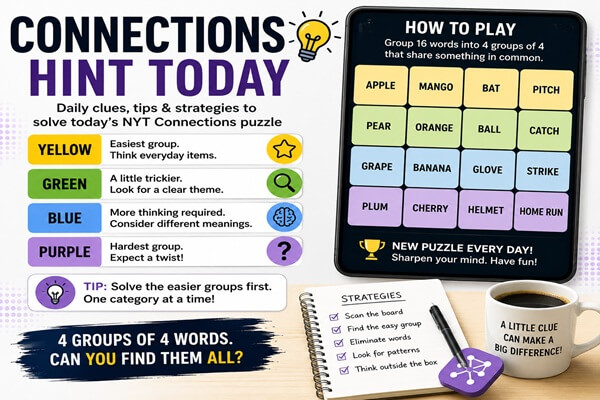
The basic puzzle gives you 16 words.
Your job is to divide those words into four groups of four.
Each group has something in common.
Sometimes the connection is obvious.
Sometimes it is based on a phrase.
Sometimes the words have a particular meaning.
And sometimes the hardest category depends on wordplay that you probably wouldn’t notice immediately.
That’s why players search for hints rather than answers.
A hint can give you the direction without taking away the satisfaction of solving the group yourself.
How Connections Works
The rules are simple.
You get a board containing 16 words or phrases.
There are four hidden categories.
Each category contains exactly four answers.
Your job is to identify all four groups.
The game gives you a limited number of mistakes, so randomly testing combinations isn’t a great strategy.
The four groups are also associated with different colors:
- Yellow is generally the easiest.
- Green is a little more difficult.
- Blue usually requires more lateral thinking.
- Purple is typically the trickiest and often involves wordplay.
This difficulty structure is one of the reasons Connections is more interesting than a simple matching game. A player may solve three categories quickly and then spend several minutes trying to understand the final four words.
The trick is that a word can appear to belong to several groups.
That is intentional.
Why Today’s Connections Puzzle Can Feel So Difficult
The hardest part of Connections isn’t finding four related words.
It’s finding exactly four words that belong together better than the alternatives.
Imagine the board contains:
APPLE
ORANGE
PEAR
MANGO
PITCH
BAT
BALL
CATCH
You may quickly see fruits and baseball-related words.
That’s easy.
Real Connections puzzles aren’t usually that generous.
Instead, a word might fit one obvious category while also being part of a completely different category.
That’s where mistakes happen.
The puzzle designers deliberately include words that create false connections.
A player might find three words that clearly belong together and then force a fourth word into the group simply because it seems close enough.
That is usually a warning sign.
How to Use the Mashable Connections Hint Without Spoiling It
If you want help but still want to solve the puzzle yourself, don’t jump straight to the answer section.
Start with the weakest possible hint.
For example, suppose the clue says:
Yellow: Something you might find at a restaurant
That’s enough to narrow your thinking without telling you the four answers.
Try solving that category first.
If you’re still stuck, move to a stronger clue.
A good solving progression is:
Level 1: General theme
Level 2: Category description
Level 3: Think about specific words
Level 4: Full category
Level 5: Complete answers
This approach keeps the game enjoyable.
The goal isn’t simply to finish the board as quickly as possible. For many players, the satisfying part is the moment when a strange group suddenly makes sense.
Today’s Connections Hints: Start With the Categories
When looking for the Connections hint today, category clues are usually more useful than individual-word clues.
Why?
Because the category tells you what kind of relationship you’re searching for.
Consider the difference between these two hints:
Weak clue: “Think about things related to travel.”
Better clue: “Things found at an airport.”
The second clue dramatically reduces the possibilities.
You can now scan the 16 words for terms associated with airports.
That’s the kind of mental shortcut that makes a difficult puzzle manageable.
Mashable’s recent Connections articles use this general approach, giving short clues before revealing the actual categories and solutions.
Don’t Start With Purple
This is one of the biggest mistakes new Connections players make.
They see an unusual word and immediately try to figure out the hardest category.
Don’t.
Start with the easiest group.
Yellow is normally your best starting point because it tends to have the most direct connection.
Once you remove four words from the board, the remaining 12 become easier to analyze.
Then find another obvious group.
After two groups are gone, you only have eight words left.
At that point, the difficult categories become much easier to see.
It’s basically a process of elimination.
Look for Obvious Groups First
Before thinking about wordplay, scan the board for obvious relationships.
Ask yourself:
Are there four foods?
Four names?
Four verbs?
Four objects?
Four places?
Four things associated with a particular sport?
Four words that can follow the same word?
Four words that can come before another word?
These basic questions can reveal the first category.
Don’t overthink the opening move.
The puzzle gets harder later.
Also read: The Flying Elephant Memoirs of An Olympic Champion
Watch Out for the Fourth Word
This is where Connections becomes clever.
You find three words that clearly belong together.
Then you need the fourth.
That’s when the puzzle tries to trick you.
Suppose you identify:
APPLE
PEAR
PLUM
?
You might immediately choose another fruit.
But perhaps one of those three belongs to a different category and the real group is based on something else entirely.
Whenever you have three words and can’t confidently identify the fourth, stop.
Look at the entire board again.
Ask:
“Could one of these three belong somewhere else?”
That question saves a lot of mistakes.
Connections Is About Relationships, Not Definitions
A common mistake is looking only at dictionary meanings.
Connections can use much broader relationships.
Two words might connect because they:
- Form a common phrase.
- Precede the same word.
- Follow the same word.
- Have the same abbreviation.
- Refer to characters.
- Are brands.
- Are locations.
- Sound alike.
- Differ by one letter.
- Become another word when something is added.
- Have a connection to a particular person or subject.
That is why simply knowing the definitions isn’t enough.
You need to think about how words are used.
Why Mashable’s Hints Are Useful
One reason people repeatedly search for Mashable Connections hints today is that the hints generally give enough direction to keep the player moving without immediately dumping the complete solution.
Mashable’s recent articles follow a familiar structure.
First comes a short introduction to the day’s puzzle.
Then readers can look at hints.
After that, Mashable identifies the categories.
Finally, the complete answers are revealed.
That structure works well because different players want different amounts of help.
Someone stuck on one category can stop after reading a clue.
Someone who has completely given up can continue to the answers.
How to Solve Connections Faster
Speed isn’t everything, but if you want to improve your solving time, there are a few habits worth developing.
1. Scan for Proper Nouns
Look for names of:
- People
- Cities
- Countries
- Brands
- Movies
- TV shows
- Characters
- Companies
Connections often uses familiar names in unexpected ways.
2. Look for Repeated Word Patterns
A word may form a phrase with another word.
For example:
___ HOUSE
could potentially lead you toward words such as:
GREEN
WHITE
FULL
POWER
The actual category may not be “types of houses.”
It could be words that precede HOUSE.
This distinction is important.
3. Check for Homophones
Purple categories sometimes depend on how a word sounds rather than how it is spelled.
A word may sound like:
- A person’s name
- A profession
- Another common word
- A title
- A place
If the last four words seem completely unrelated, say them aloud.
That can reveal the connection.
4. Think About Prefixes and Suffixes
Some groups are built around words that can follow or precede the same expression.
If four words look unrelated, try adding a common word before them.
Then try adding one after them.
You may suddenly see the pattern.
The Four Connections Colors Explained
Yellow
Yellow is usually the easiest group.
The connection tends to be fairly direct.
You might see four obvious types of food, objects, activities, or common terms.
Solve this first whenever possible.
Green
Green usually requires a little more thought.
The words may share a relationship that isn’t immediately visible, but the category is still fairly accessible.
Blue
Blue is where many players begin slowing down.
The group might involve a specific subject, phrase, cultural reference, or less obvious relationship.
Purple
Purple is usually where the puzzle saves its biggest trick.
This category can involve:
- Wordplay
- Homophones
- Letter changes
- Phrases
- Pop culture
- Unusual meanings
- Hidden patterns
If you’ve solved the other three groups, purple becomes much easier because you know which four words remain.
What to Do When You Have Two Possible Groups
This happens constantly.
You might have six words that appear to form two overlapping groups.
Don’t guess immediately.
Write down both possibilities mentally.
Then examine the remaining words.
The correct group should leave a sensible category behind.
This is an important Connections principle:
A category isn’t correct just because four words fit it.
It needs to be the intended relationship, and the other 12 words must still be capable of forming three clean groups.
Think of the entire board as one puzzle rather than four separate puzzles.
The “One Word Doesn’t Fit” Problem
If three words clearly belong together and one feels forced, don’t submit.
That’s often the puzzle telling you that you’ve found a trap.
Connections frequently places a tempting fourth word next to three correct answers.
The word may share a general meaning but not the exact relationship.
For example, four words might all relate to music, but the intended category could specifically be types of musical instruments.
The broader connection isn’t enough.
The game wants the more precise grouping.
Why You Should Avoid Random Guesses
You only get a limited number of incorrect attempts.
A random guess can destroy an otherwise perfect solve.
Instead of selecting four words because they “feel right,” try to explain the connection in one sentence.
If you can’t explain why all four belong together, you’re probably not ready.
Ask:
“What exactly links these four?”
If your answer is something vague like “They’re all kind of related to sports,” keep looking.
If your answer is precise, such as “These are all words that can follow ___,” you probably have something solid.
Mashable Connections Hint Today vs. Full Answers
There are two types of players.
Some want the smallest possible clue.
Others just want the answer.
Neither is wrong.
If you are maintaining a daily streak, a hint may be enough to save the puzzle without ruining the experience.
If you’ve already spent 20 minutes on the final category, looking at the answer may be more enjoyable than staring at the screen indefinitely.
The important thing is to choose the amount of help you actually need.
How to Avoid Spoilers
If you’re searching Mashable Connections hint today, be careful when scrolling.
Daily puzzle articles often contain the complete answers further down the page.
The best approach is:
- Read the introduction.
- Look only at the hint section.
- Return to the puzzle.
- Try again.
- Reveal the category if necessary.
- Only then check the full answer.
This gives you several opportunities to solve the puzzle yourself.
What Makes Connections Different From Wordle?
Wordle asks you to identify one word.
Connections asks you to identify relationships.
That’s a major difference.
With Wordle, you’re narrowing down letters.
With Connections, you’re narrowing down meanings and associations.
A strong Connections player therefore isn’t necessarily someone with the largest vocabulary.
The game rewards flexible thinking.
You need to move between literal meanings, phrases, categories, sounds, names, and cultural references.
That is what makes the puzzle so addictive.
Why People Search for Connections Hints Every Day
The daily reset creates a simple habit.
You solve today’s puzzle.
Tomorrow there’s another one.
The difficulty changes.
Some days feel easy.
Other days seem impossible.
A player who normally solves the puzzle in five minutes might spend half an hour on another day’s board.
That’s where searches for Connections hints today become useful.
People don’t necessarily want someone to solve the puzzle for them.
They want a nudge.
One clue can be enough to unlock an entire category.
How to Build a Better Connections Strategy
If you play every day, don’t focus only on your score.
Pay attention to the types of connections that fool you.
Maybe you frequently miss categories based on phrases.
Maybe proper names cause problems.
Maybe you always fall for the obvious-looking red herring.
Once you know your weakness, you can improve it.
After each puzzle, ask:
What fooled me?
Which category did I see first?
Which word caused confusion?
Was the final category based on meaning, spelling, sound, or a phrase?
This turns the game into a learning exercise rather than simply a daily score.
A Simple Five-Step Method
Here’s a strategy you can use every day.
Step 1: Scan the Entire Board
Don’t immediately select four words.
Read all 16 first.
Look for obvious categories.
Step 2: Find the Easiest Group
Yellow is normally the best target.
Remove it.
Step 3: Reassess
The remaining 12 words may reveal a new pattern.
Don’t keep using your original assumptions.
Step 4: Test the Exact Connection
Make sure every word fits for the same reason.
Step 5: Leave the Hardest Group Until Last
Once you’ve solved three groups, the remaining four words are your final category.
This method dramatically reduces unnecessary guesses.
Today’s Puzzle: When You Need Just One More Nudge
If you’re stuck on the Mashable Connections hint today, don’t immediately search for the full answer.
Try identifying which color is giving you trouble.
If yellow is still unsolved, look for the most obvious shared relationship.
If green is causing trouble, think about phrases and categories.
If blue seems impossible, look for a narrower subject connection.
If purple is left, assume the puzzle is probably asking you to think differently from the literal meaning of the words.
That mindset alone can make a difficult board feel much more manageable.
Frequently Asked Questions
What is Mashable Connections?
Mashable Connections generally refers to Mashable’s daily coverage of the New York Times Connections word puzzle. Mashable publishes hints and solutions to help players work through the day’s 16-word grid.
What is the Mashable Connections hint today?
The exact hint changes every day because the Connections puzzle changes daily. If you’re looking for the current day’s clues, use the latest Mashable Connections article and stop at the hint section if you don’t want spoilers.
How many words are in Connections?
Each puzzle contains 16 words or phrases, which must be divided into four groups of four.
How many groups are there?
There are four groups, with four words in each group.
What do the Connections colors mean?
The colors indicate difficulty. Yellow is generally easiest, followed by green, blue, and purple.
Which Connections category should I solve first?
Start with the most obvious group. In many puzzles, that’s the yellow category.
Why is the purple category so difficult?
Purple is generally designed to be the hardest category and often relies on wordplay, unusual associations, phrases, spelling patterns, or cultural knowledge.
How many mistakes can you make?
The game gives players a limited number of incorrect guesses, so it’s better to submit a group only when you can explain the exact connection.
Should I use Connections hints?
Yes, especially if you’re stuck. A small hint can help you understand the intended relationship without giving away all four answers.
Are Mashable’s Connections hints the same as the answers?
No. Mashable’s format generally separates hints from the full solution. Its recent coverage provides clues first, then categories, followed by the complete word groups.
Is Connections harder than Wordle?
That’s subjective. Wordle focuses on identifying one five-letter word, while Connections requires recognizing four different relationships among 16 words. Many players find Connections harder because of the deliberate overlapping possibilities.
Can I solve Connections without hints?
Absolutely. The best strategy is to identify the obvious group first, remove it, and then reassess the remaining words.
What should I do if five words seem to fit?
That’s usually a sign that one of your assumptions is wrong. Look for the more precise relationship and identify the word that doesn’t truly belong.
Final Thoughts
The reason people search for Mashable Connections hint today isn’t complicated.
Connections can be deceptively hard.
The board contains only 16 words, but those words can be connected in several different ways. The puzzle deliberately encourages you to notice relationships that may not be the intended ones.
That’s why a good hint can make such a difference.
You don’t always need the answer.
Sometimes you just need to know whether you’re looking for a type of object, a phrase, a person’s name, a word pattern, or something completely different.
Mashable’s daily coverage is useful for exactly that reason. Its recent Connections articles give readers a chance to see clues before moving on to the categories and full solutions.
For the best solving experience, start with the easiest group, avoid forcing a fourth word into a category, and save the strangest-looking group for later.
And if today’s puzzle has you completely stuck, there’s nothing wrong with taking a hint.
Just don’t scroll too far unless you’re ready for the spoilers.