do the driving modes in cadillac lyriq offer different ranges or battery usages?
What actually changes when you switch between Tour, Sport, Snow/Ice, and My Mode
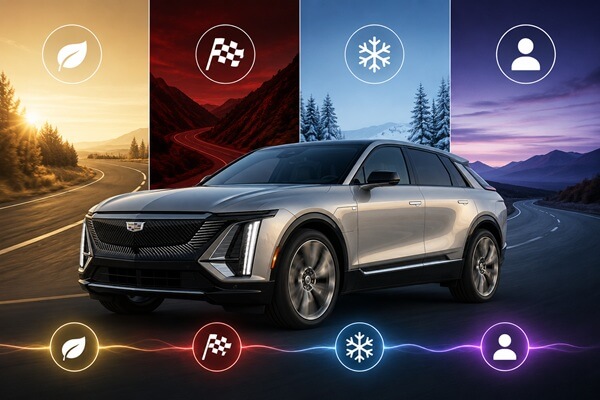
Switching driving modes in the Cadillac LYRIQ does not change the battery’s capacity or create a separate official EPA range rating. What changes is the vehicle’s calibration and response. Tour is designed for smooth everyday driving, Sport provides a more immediate and performance-focused response, Snow/Ice changes accelerator and torque response to help reduce wheel slip, and My Mode lets drivers customize several characteristics. Those differences can affect real-world energy consumption, especially when a more responsive mode encourages harder acceleration.
The Cadillac LYRIQ is an electric SUV, so questions about driving modes and range are slightly different from questions about traditional gasoline vehicles. There is no engine transmission shifting through different gears to create a completely different mechanical operating range. Instead, the LYRIQ’s driving modes change how the vehicle responds to the driver’s inputs and to road conditions.
That distinction is important.
If you switch from Tour to Sport, the LYRIQ doesn’t suddenly gain a smaller battery. Likewise, selecting Snow/Ice doesn’t give you a special winter battery setting. The same battery remains installed in the vehicle. What changes is the way the vehicle’s systems are calibrated.
Cadillac currently lists the LYRIQ battery platform at 102 kWh rated energy capacity. The 2026 LYRIQ single-motor RWD is listed with up to 326 miles of EPA-estimated range, while available dual-motor AWD versions are listed at up to 319 miles. Cadillac separately lists the LYRIQ-V at 285 miles of Cadillac-estimated range.
Those figures are associated with vehicle configuration, not a promise that the same LYRIQ will have one EPA range in Tour and another in Sport.
The interesting question is therefore not whether the driving modes change the battery itself.
It is whether your choice of mode can change how quickly you use the energy in that battery.
And the answer to that is yes.
Driving Modes at a Glance
| Driving Mode | Main Purpose | How It Changes the Driving Experience | Potential Effect on Energy Use |
|---|---|---|---|
| Tour | Everyday driving | Smooth, comfortable calibration | Generally a sensible choice for efficiency |
| Sport | More engaging driving | More immediate torque response and sharper steering | Can increase consumption when used aggressively |
| Snow/Ice | Slippery conditions | Softer accelerator and torque response | Prioritizes traction rather than maximum range |
| My Mode | Personalization | Customizable accelerator, steering and braking characteristics | Depends on configuration and driving style |
Cadillac describes Tour as the predominant everyday mode, Snow/Ice as a mode intended to help prevent wheel spin, Sport as a mode with more immediate torque response and enhanced road connection, and My Mode as a customizable setting.
Does Changing the LYRIQ Driving Mode Change Battery Capacity?
No.
This is the first thing to understand.
The LYRIQ’s battery doesn’t become larger in Tour mode or smaller in Sport mode.
If your vehicle has a 102-kWh rated battery, selecting Sport doesn’t turn it into a 90-kWh battery. Selecting Tour doesn’t increase it to 110 kWh.
The physical battery system remains the same.
What changes is how the vehicle uses the energy available from that battery.
Think about it like using the same amount of fuel in a gasoline car. Changing the way the accelerator responds doesn’t change the size of the fuel tank. It can, however, affect how quickly fuel is consumed.
The same basic principle applies to an EV.
Does Sport Mode Use More Battery?
It can, particularly when the driver takes advantage of the more aggressive response.
Cadillac says Sport mode is calibrated for an enhanced feeling of road connection, more immediate torque response and improved steering at higher speeds.
That’s useful if you’re looking for a more engaging driving experience.
But stronger acceleration requires energy.
Electric motors are capable of delivering substantial torque very quickly. If you repeatedly accelerate hard, the vehicle has to draw more power from the battery.
For example, imagine two LYRIQ drivers traveling the same 100-mile route.
The first driver uses Tour mode, accelerates smoothly and maintains a steady highway speed.
The second driver uses Sport mode and repeatedly takes advantage of the quicker response, accelerating aggressively from intersections and passing frequently.
Even though both vehicles have the same battery, the second driver may consume more energy.
The important point is that Sport mode isn’t necessarily “wasting” electricity by itself.
The driver’s behavior is the bigger factor.
That’s why there isn’t a simple rule such as:
Sport mode always reduces LYRIQ range by 10%.
Cadillac doesn’t publish a universal percentage like that.
Actual energy consumption depends on speed, acceleration, weather, terrain, tires, climate control and many other variables.
Tour Mode: The Best Choice for Everyday Efficiency?
For most drivers who simply want comfortable everyday driving, Tour is the logical starting point.
Cadillac describes Tour as the predominant mode for everyday driving, with tuning and calibration designed around a smooth ride.
That makes Tour particularly appropriate for:
- Commuting
- City driving
- Normal highway trips
- Family driving
- Long-distance cruising
- Drivers who aren’t looking for maximum performance
But Tour isn’t a magic range-saving button.
A driver can still get poor efficiency in Tour.
For example, driving at very high highway speeds, accelerating aggressively or carrying a heavy load can consume considerably more energy.
So the better way to think about Tour is:
Tour makes efficient, smooth driving easier; it doesn’t guarantee maximum range.
Sport Mode: Performance Comes First
Sport is designed for drivers who want a more responsive experience.
Cadillac specifically describes Sport as providing more immediate torque response and improved steering at higher speeds.
That can make the LYRIQ feel more eager when you press the accelerator.
The trade-off is straightforward.
More acceleration requires more energy.
If you’re using Sport simply because you prefer the steering and pedal response, the range difference may be relatively small.
If you’re constantly using the extra performance, the difference can become much more noticeable.
This is why two LYRIQ owners can report very different real-world range even when they own essentially the same vehicle.
One may regularly achieve excellent efficiency.
Another may regularly see much higher energy consumption.
The drive mode is only part of the explanation.
Snow/Ice Mode: Range Isn’t the Main Goal
Snow/Ice mode is different from Tour and Sport because its purpose isn’t primarily comfort or performance.
It’s designed for slippery conditions.
Cadillac says Snow/Ice adjusts the pedal map, slowing acceleration and torque response to help prevent wheel slip and improve performance on slippery surfaces.
That makes sense in situations where excessive torque at the wheels could cause traction problems.
You shouldn’t choose Snow/Ice simply because you expect it to deliver the longest possible range.
If you’re driving on dry pavement, Tour is generally the more natural everyday setting.
If you’re driving on snow or ice, however, traction and control are much more important than trying to save a small amount of energy.
There’s also another factor that can overwhelm the difference between modes:
cold weather.
Cold temperatures can affect EV range, while heating the cabin also consumes energy.
So if your LYRIQ shows substantially less estimated range during winter, don’t automatically assume Snow/Ice mode is responsible.
My Mode: What Does It Do?
My Mode is designed for personalization.
Cadillac says My Mode allows drivers to change characteristics including accelerator responsiveness, steering feel, braking responsiveness and Electric Vehicle Sound Enhancement.
That means there isn’t one universal energy-consumption number for My Mode.
It depends on how you configure it and how you drive.
A driver could configure a relatively relaxed setup.
Another driver could create something closer to a performance-oriented driving experience.
Therefore, asking whether My Mode gives better range doesn’t really have a single answer.
It’s better described as a customization option.
What About Regenerative Braking?
Regenerative braking is much more directly connected to EV efficiency.
Cadillac describes LYRIQ regenerative braking as a way to conserve and capture braking energy for added range.
When the vehicle slows, the electric motors can operate in a way that converts some of the vehicle’s kinetic energy back into electrical energy.
That energy can then be returned to the battery.
But regeneration doesn’t mean you get all the energy back.
There are losses during acceleration, mechanical movement, electrical conversion and regeneration.
That’s why the most efficient driving strategy isn’t:
Accelerate hard → brake hard → regenerate.
It’s:
Accelerate smoothly → maintain speed → anticipate traffic → slow gradually.
Regeneration is useful, but avoiding unnecessary energy expenditure is even better.
Does One-Pedal Driving Improve LYRIQ Range?
It can help in the right circumstances.
Cadillac’s One-Pedal Driving system allows the vehicle to slow and stop using the accelerator pedal under normal driving conditions. The LYRIQ provides Off, On/Normal and High settings, with High providing greater deceleration when the accelerator is released.
This can be particularly useful in city traffic.
Imagine you’re approaching a red light.
Instead of continuing to accelerate and then braking heavily at the last moment, you can anticipate the light and gradually release the accelerator.
The vehicle slows through regenerative braking.
That’s a much more efficient pattern.
However, Cadillac also notes that One-Pedal Driving isn’t recommended for slippery roads and that its operation can be limited in certain battery-temperature or state-of-charge conditions.
So it should be treated as a driving tool, not a universal range-maximizing setting.
Which Has a Bigger Effect: Driving Mode or Speed?
Usually, speed is the bigger factor.
Aerodynamic drag increases significantly as vehicle speed rises.
That means a LYRIQ driven at a high highway speed can consume considerably more energy than the same vehicle driven at a moderate speed.
This is why changing from Sport to Tour won’t necessarily transform your range if you continue driving aggressively at high speeds.
For long trips, smooth acceleration and reasonable cruising speed can matter more than the drive-mode selector.
Does Climate Control Affect LYRIQ Range?
Yes.
Heating and cooling require energy.
This is especially noticeable in extreme temperatures.
In very hot weather, air conditioning has to work harder.
In very cold weather, cabin heating can consume significant electrical energy.
Battery temperature also matters.
Cadillac notes that actual range can vary depending on factors including temperature, terrain, battery age and loading.
That’s why comparing two trips based only on driving mode can produce misleading conclusions.
A Tour-mode trip on a mild spring day and a Sport-mode trip in freezing weather aren’t controlled experiments.
Does Terrain Affect Range?
Absolutely.
A LYRIQ traveling uphill needs additional energy to gain elevation.
On a downhill section, regenerative braking can recover some energy.
But, as with braking generally, you don’t recover everything that was used to climb.
A mountainous road can therefore produce very different efficiency from a flat route.
Again, this can easily be larger than the difference caused by changing from Tour to Sport.
Do Tires Affect LYRIQ Range?
Yes.
Tire pressure, tire design, wheel size and road surface all influence rolling resistance and energy consumption.
If you’re trying to compare driving modes, make sure you’re not also comparing different tire setups.
Otherwise, you could mistakenly blame the drive mode for an efficiency difference actually caused by tires or wheels.
Does Vehicle Weight Matter?
Yes.
Passengers and luggage add weight.
More weight means the vehicle requires more energy to accelerate.
The effect isn’t necessarily dramatic during every drive, but over hundreds of miles it can contribute to different energy consumption.
This is another reason official EPA range shouldn’t be treated as a guaranteed number for every real-world situation.
Why Does the LYRIQ’s Estimated Range Keep Changing?
This can confuse new EV owners.
You may start with an estimated 300 miles.
After driving 50 miles, the display might not say 250 miles remaining.
It could show significantly more—or significantly less.
That’s because the estimated range is based on expected energy consumption.
If your recent driving has been efficient, the vehicle may estimate that you can travel farther.
If your recent driving has consumed more energy, the estimate can fall faster.
So don’t interpret every change in the range display as a direct change in battery capacity.
The battery hasn’t suddenly shrunk.
The vehicle is updating its prediction.
Does Sport Mode Damage the LYRIQ Battery?
Using Sport mode normally does not mean you’re damaging the battery.
The LYRIQ is engineered to provide different driving characteristics.
Sport mode is an intended feature of the vehicle.
The main practical difference is energy consumption.
If you’re using the performance available in Sport frequently, you’ll naturally use more energy.
That may mean more frequent charging.
But that’s very different from saying that simply selecting Sport permanently damages the battery.
Does Tour Mode Charge the Battery Faster?
No.
Driving mode and charging speed are separate things.
The 2026 LYRIQ uses a 102-kWh rated battery platform, and Cadillac lists different AC charging capabilities depending on configuration, including standard 11.5-kW and available 19.2-kW Level 2 charging. Cadillac also lists DC fast charging capability of up to 190 kW on its current specifications page.
Selecting Tour doesn’t make the charger deliver electricity faster.
Charging depends on the charger, vehicle configuration, battery condition, temperature and other factors.
Can Driving Mode Change the Official EPA Range?
No.
This is one of the most important distinctions.
Cadillac’s official range numbers are associated with vehicle configuration.
For example, Cadillac currently lists:
| LYRIQ Configuration | Published Range |
|---|---|
| Single-motor RWD | Up to 326 miles EPA-estimated |
| Dual-motor AWD | Up to 319 miles EPA-estimated |
| LYRIQ-V | 285 miles Cadillac-estimated |
These differences aren’t created by switching between Tour and Sport.
They come from differences in powertrain and vehicle configuration.
The LYRIQ-V, for example, uses dual-motor AWD and is rated at 615 horsepower with a Cadillac-estimated 285-mile range.
Which LYRIQ Mode Is Best for Maximum Range?
If your goal is simply to maximize range during normal driving, Tour is the sensible default.
But don’t stop there.
The biggest gains usually come from your driving habits.
For maximum practical range:
- Use Tour for normal driving.
- Accelerate smoothly.
- Avoid unnecessary hard launches.
- Maintain reasonable highway speeds.
- Anticipate traffic.
- Use regenerative braking effectively.
- Avoid unnecessary braking and acceleration cycles.
- Keep tires properly inflated.
- Use climate control intelligently.
- Monitor actual energy consumption rather than relying only on the estimated range.
What About Long Road Trips?
For road trips, driving mode matters, but planning matters more.
Cadillac’s LYRIQ ecosystem includes route planning and charging information designed to help drivers locate compatible charging stations and plan journeys.
The vehicle also supports battery preparation for DC fast charging through its charging system and navigation features.
For a long trip, pay attention to:
- Starting battery percentage
- Weather
- Highway speed
- Terrain
- Charging stations
- Expected arrival state of charge
- Charger availability
- Vehicle configuration
A few miles of theoretical range gained from a driving mode isn’t nearly as useful as knowing where your next reliable charging stop is.
How to Test Tour vs. Sport Yourself
If you’re curious about the actual difference in your own LYRIQ, you can perform a simple comparison.
Don’t compare two completely different trips.
Instead:
Test 1: Tour
Test 2: Sport
Keep as many variables identical as possible.
Use the same route.
Drive at similar speeds.
Start with similar battery percentages.
Keep the climate-control settings similar.
Keep the vehicle load similar.
Then compare your energy consumption.
For example:
| Test | Mode | Distance | Energy Efficiency |
|---|---|---|---|
| Test A | Tour | 100 miles | 3.0 mi/kWh |
| Test B | Sport | 100 miles | 2.7 mi/kWh |
The numbers above are only an example, not a claimed Cadillac test result.
The important measurement is your actual energy consumption.
Repeat the test several times before drawing conclusions.
One trip isn’t enough to prove that one mode is universally more efficient.
The Biggest Mistake When Comparing Driving Modes
The biggest mistake is changing multiple variables at the same time.
For example:
- Tour on city roads
- Sport on highway roads
- Tour in mild weather
- Sport in cold weather
- Different tire pressures
- Different passenger loads
Then comparing the range.
That doesn’t tell you much about the driving mode.
A useful comparison isolates the variable you’re testing.
The more consistent the conditions, the more meaningful the result.
Frequently Asked Questions
Does Sport mode reduce LYRIQ range?
It can reduce real-world efficiency when the more responsive calibration leads to harder or more frequent acceleration. Cadillac does not publish a universal fixed percentage of range loss for Sport mode.
Does Tour mode give the LYRIQ more range?
Tour is designed for smooth everyday driving and is a sensible choice when efficiency is a priority. However, actual range depends heavily on speed, driving style, weather, terrain and other factors.
Does changing driving mode change the LYRIQ battery size?
No. Selecting Tour, Sport, Snow/Ice or My Mode doesn’t change the physical battery capacity.
Does Snow/Ice mode save battery?
Its primary purpose is traction. Cadillac says it changes pedal mapping and slows acceleration and torque response to help prevent wheel slip.
Does regenerative braking improve LYRIQ range?
Regenerative braking can recover some energy during deceleration. Cadillac specifically describes regenerative braking as helping conserve and capture braking energy for added range.
Is Tour or Sport better for highway driving?
Tour is generally the more sensible choice when efficiency is the priority. However, highway speed has a major effect on energy consumption regardless of the selected mode.
Which LYRIQ mode is best in snow?
Snow/Ice is designed for slippery surfaces and adjusts accelerator and torque response to help reduce wheel slip.
Does My Mode change the battery range?
My Mode doesn’t change battery capacity. It allows you to customize driving characteristics, so actual energy consumption depends on how the mode is configured and how you drive.
Does One-Pedal Driving increase range?
It can help efficiency in situations where it reduces unnecessary braking and allows more energy to be recovered through regeneration. Cadillac provides Normal and High levels of One-Pedal Driving.
What affects LYRIQ range more than driving mode?
Speed, temperature, terrain, climate control, tires, vehicle loading, battery condition and driving style can all have substantial effects on real-world range.
Does Sport mode damage the battery?
Simply using Sport mode as designed does not mean the battery is being damaged. The main practical consequence of aggressive driving is greater energy consumption.
Does Tour mode charge faster?
No. Charging speed is determined by the charging system, vehicle configuration and charging conditions, not by whether the vehicle is in Tour or Sport.
How much range does the 2026 LYRIQ have?
Cadillac currently lists up to 326 miles of EPA-estimated range for single-motor RWD LYRIQ models and up to 319 miles for available dual-motor AWD models.
Does the LYRIQ have a 102-kWh battery?
Cadillac lists the LYRIQ EV SUV battery platform at 102 kWh rated energy capacity.
Final Verdict
The Cadillac LYRIQ’s driving modes can affect real-world energy consumption, but they do not change the battery’s physical capacity or create separate official EPA range ratings.
Tour is the everyday mode and the logical choice when you want smooth, predictable driving. Sport provides a more immediate response and can use more energy when you take advantage of its performance. Snow/Ice changes torque and accelerator response to help with traction, while My Mode lets you customize the driving experience.
The biggest takeaway is that driving behavior matters more than the mode name.
A smooth Sport-mode driver may use less energy than an aggressive Tour-mode driver.
If maximizing range is your priority, focus on the things that really move the needle: moderate speeds, smooth acceleration, anticipating traffic, appropriate tire pressure, sensible climate-control use and effective regenerative braking.
The LYRIQ’s battery remains the same.
What changes is how you use the energy inside it.