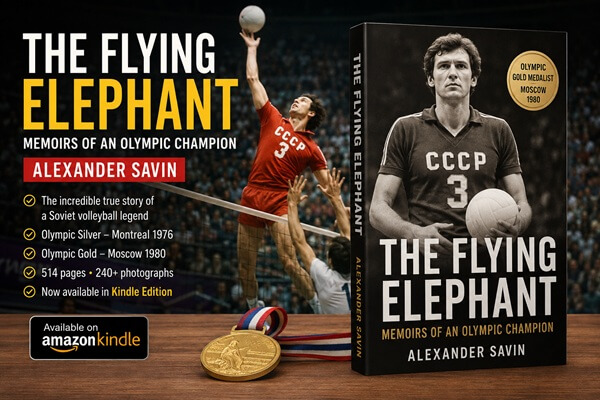
The Flying Elephant Memoirs of An Olympic Champion
A good sports memoir should do more than list medals.
The interesting part is what happened before the medal, what the athlete had to give up to get there, and what life looked like when the competition was over.
That is the appeal of The Flying Elephant: Memoirs of an Olympic Champion by Alexander Savin.
Savin was a Soviet volleyball player who competed at the highest level during one of the most important periods in the sport’s history. He won Olympic silver at Montreal in 1976 and Olympic gold at Moscow in 1980. His career also included major international titles with the Soviet national team, making him an important figure in the story of Soviet volleyball.
The English-language The Flying Elephant memoirs of an Olympic Champion Kindle edition Alexander Savin gives modern readers access to that story in digital form. Reports about the edition describe a substantial 514-page book containing more than 240 photographs, including material drawn from family collections and archival sources.
But the biggest reason to pay attention to this book isn’t simply the Olympic gold medal.
It is the period Savin represents.
His career developed during the golden era of Soviet volleyball, when the USSR was one of the dominant forces in international competition. The memoir therefore works on two levels: it is the story of one elite athlete, but it is also a window into a sporting system, a generation of players, and an era that is becoming increasingly distant.
Quick Facts About the Book
| Detail | Information |
|---|---|
| Book | The Flying Elephant: Memoirs of an Olympic Champion |
| Author | Alexander Savin |
| Subject | Volleyball / sports memoir |
| Olympic highlight | Gold medal, Moscow 1980 |
| Earlier Olympic result | Silver medal, Montreal 1976 |
| Reported length | 514 pages |
| Photographs | 240+ |
| Format discussed here | Kindle edition |
| Historical setting | Soviet-era international volleyball |
| English edition | Reported as a translated edition |
The reported publication information and edition details come from current third-party coverage of the book and should be checked against the retailer listing before purchase because digital-book availability and specifications can change.
Who Is Alexander Savin?
To understand why Alexander Savin the Flying Elephant Memoirs of an Olympic Champion is worth discussing, it helps to understand the athlete behind the book.
Savin was born in 1957 and became a prominent Soviet volleyball middle blocker. His international career ran through the 1970s and 1980s, a period when Soviet volleyball had enormous influence on the world game. Contemporary book coverage identifies him as an Olympic champion and later a contributor to volleyball beyond his playing career.
His Olympic record alone gives the memoir a compelling structure.
At the 1976 Montreal Olympics, Savin won silver with the Soviet team.
Four years later, at the 1980 Moscow Olympics, he went one step further and won gold.
That progression matters because it gives the book something that many sports biographies don’t have: the experience of losing on the biggest stage and then returning four years later to win.
An Olympic silver medal is an extraordinary achievement, but athletes don’t always experience it that way immediately after a final.
For a competitor who has spent years preparing for one event, second place can feel very different from how it looks on a medal table.
The journey from Montreal to Moscow therefore provides an important part of Savin’s sporting story.
From Olympic Silver to Gold
The four-year gap between Montreal and Moscow is one of the most interesting periods to consider when reading The Flying Elephant memoirs of an Olympic champion Alexander Savin.
In 1976, Savin experienced Olympic success but not the result he ultimately wanted.
By 1980, the Soviet team won gold on home soil.
That change wasn’t simply about adding another medal.
Elite sport rarely works that way.
An athlete doesn’t lose an Olympic final and automatically become better four years later. There are changes in training, teammates, tactics, physical preparation, confidence and competition. There are also injuries, personal problems and the ordinary exhaustion that comes from maintaining an elite career.
This is one reason memoirs written by the athletes themselves can be more interesting than standard career summaries.
A statistics page can tell you what happened.
A memoir can explain what those years felt like.
What Does The Flying Elephant Mean?
The title is one of the first things that catches a reader’s attention.
Why call a volleyball memoir The Flying Elephant?
The phrase plays on the contrast between physical power and movement.
Savin was a large and powerful middle blocker, but volleyball requires explosive movement. A player at the net needs to jump, react, block, attack and move quickly despite having a large physical frame.
The nickname therefore captures an apparent contradiction: something heavy appearing to fly.
Several current reviews interpret the title as a metaphor for achieving something that initially seems impossible.
That interpretation works beyond volleyball.
An Olympic athlete has to make extraordinary physical performance look normal.
A jump lasts only a moment.
A block may take less than a second.
A powerful attack might be remembered for one spectacular image.
Behind that image are years of repetition.
That’s the part casual sports coverage often misses.
The Soviet Volleyball Era
Perhaps the most valuable historical element of The Flying Elephant: Memoirs of an Olympic Champion is its connection to Soviet volleyball.
The Soviet Union produced generations of elite athletes across many sports, and volleyball was no exception.
International volleyball during the 1970s and 1980s was highly competitive, with the Soviet program operating at a level that made its players major figures in the sport.
Savin’s career unfolded inside that environment.
That makes the memoir useful even for readers who aren’t primarily interested in one player’s biography.
It offers a chance to understand how an athlete developed inside a system where sport was treated as a serious national pursuit.
Training wasn’t simply something athletes did after school or work.
For elite competitors, it became a way of life.
The distinction is important.
Modern professional athletes have access to sophisticated facilities, nutrition programs, analytics and sports science. Soviet athletes worked within a very different historical and institutional environment.
Reading Savin’s perspective provides a comparison between those eras.
More Than an Olympic Story
It would be easy to market the book as simply the story of an Olympic champion.
That would undersell it.
The more interesting question is what it means to spend a significant part of your life preparing for elite competition.
The Olympics provide the obvious climax, but the road to the Olympics is much longer.
There are ordinary training days.
There are matches nobody remembers.
There are teammates.
There are coaches.
There are injuries.
There are disappointments.
There are periods when improvement feels slow.
And there are moments when years of preparation suddenly become visible to millions of people watching a final.
That contrast is what makes sports memoirs valuable.
The public sees the athlete at the moment of achievement.
The athlete remembers everything that came before it.
What Readers Can Expect From the Memoir
Readers searching for the Flying Elephant memoirs of an Olympic Champion Kindle edition Alexander Savin should expect a book centered on Savin’s life and volleyball career rather than a conventional instructional volleyball manual.
Current descriptions of the book emphasize several recurring subjects:
- Elite training
- Team life
- Olympic competition
- Soviet volleyball
- Personal challenges
- Leadership
- Discipline
- Competition pressure
- Life after playing
- Historical photographs
These themes appear repeatedly across the current search results, although individual reviews differ in how much emphasis they place on each subject.
That distinction is useful.
Someone looking for a technical coaching textbook may want something else.
Someone looking for the human story behind elite volleyball is much more likely to find what they want here.
The 1976 Montreal Olympics
Savin’s Olympic journey didn’t begin with gold.
His first Olympic medal was silver at Montreal 1976.
That event provides important context for the later Moscow victory.
The Olympics are often remembered through winners.
The second-place team can disappear from the story almost immediately.
For an athlete, however, an Olympic silver medal represents years of preparation and an achievement most players will never experience.
Savin’s later gold makes the story even more interesting because the two Olympic experiences can be viewed together.
Montreal represents reaching the summit but falling short of the final objective.
Moscow represents completing that journey.
That makes his career particularly relevant to readers interested in competitive resilience.
The 1980 Moscow Olympics
Four years after Montreal, Savin reached the top.
The Soviet Union won Olympic gold in volleyball at the 1980 Moscow Games, giving Savin the defining achievement of his playing career.
The location adds another layer.
This wasn’t simply another Olympic tournament.
It was the Moscow Games, held in the Soviet Union during the Cold War.
Sport and politics were closely connected during this period, and Olympic competition carried enormous national significance.
For athletes competing at home, that attention could be motivating.
It could also create pressure.
That tension makes the period particularly interesting for readers who want to understand what Olympic competition felt like from inside the Soviet system.
Savin’s Career Beyond the Olympics
The story doesn’t stop with the gold medal.
Current descriptions of the memoir also point toward Savin’s later involvement in volleyball, including coaching and mentoring.
That is an important part of any athlete biography.
Retirement creates a strange transition.
An athlete who has spent years measuring life through training schedules, competitions and team objectives suddenly has to build a different routine.
Some athletes leave their sport completely.
Others become coaches.
Others work in administration, media or development.
For someone like Savin, whose life was deeply connected with volleyball, continuing to contribute to the sport provides a natural second chapter.
It also changes how his earlier experiences can be understood.
A player sees a match differently from a coach.
A young athlete sees a teammate differently from an experienced veteran.
Those changes in perspective can make a memoir written later in life more revealing than an autobiography written immediately after retirement.
Why the Photographs Matter
One of the strongest selling points repeatedly mentioned in coverage of The Flying Elephant memoirs of an Olympic Champion is its photographic archive.
Reports describe more than 240 photographs, including images from family collections and archival material.
That matters because Soviet-era sports history isn’t equally accessible in modern English-language publishing.
A written description can tell you what a training camp looked like.
A photograph lets you see it.
You can see the uniforms.
The courts.
The teammates.
The expressions.
The surroundings.
The equipment.
The period itself.
For sports historians and volleyball fans, those details can be as valuable as the written story.
They provide visual evidence of a sporting era that is now several decades removed from everyday life.
Why The Kindle Edition Is Interesting
The Kindle format changes how a reader approaches a book like this.
A 514-page memoir containing hundreds of photographs is not a small ebook. Current listings and reviews report a file size of about 68.8 MB, which is considerably larger than a typical text-heavy Kindle book.
The reason is straightforward: photographs require much more digital storage than ordinary text.
For readers interested in the historical images, that’s actually an advantage.
A digital edition also makes the memoir easier to carry.
Instead of taking a large illustrated sports book on a trip, you can keep the entire book on a phone, tablet or Kindle-compatible device.
Kindle reading tools can also make a long memoir easier to manage.
Readers can highlight passages, search for names, add notes and return to sections later.
For someone researching Soviet volleyball, Olympic history or sports biographies, those features can be particularly useful.
Is The Flying Elephant Kindle Edition Worth Reading?
That depends on what you’re looking for.
If you want a short book that focuses only on Savin’s Olympic medal, this probably isn’t the right expectation.
The reported 514-page length indicates a much broader project.
If you’re interested in volleyball history, Olympic competition, Soviet-era sport or athlete memoirs, the book has much more to offer.
The strongest reason to read it is access to an athlete’s perspective.
There are plenty of books about famous sports events.
There are fewer books written by the people who actually lived through those events.
That’s especially true for Soviet volleyball, where much of the English-language public record naturally focuses on results rather than the personal experiences of the athletes.
Who Should Read Alexander Savin’s Memoir?
Volleyball Fans
This is the obvious audience.
If you follow volleyball closely, the opportunity to read the reflections of an Olympic champion from one of the sport’s most important eras is difficult to ignore.
Coaches
Coaches may find the book useful because it provides a player’s perspective on training, leadership and team culture.
That perspective can be different from a coaching manual.
Young Athletes
Young players can learn something important from athlete memoirs: success rarely looks like success while you’re working toward it.
Training is repetitive.
Progress can be slow.
Failure happens.
The difference between an average competitor and an elite one is often the ability to keep working through those periods.
Olympic History Readers
The Moscow 1980 Olympics occupy a unique place in sporting history.
Anyone interested in Cold War-era Olympic competition may find Savin’s firsthand perspective particularly valuable.
Sports Biography Readers
You don’t need to understand volleyball tactics to appreciate a story about ambition, pressure, competition and achievement.
Those themes are universal.
What Makes This Memoir Different From a Typical Sports Biography?
The easiest sports biographies to write are usually predictable.
Young athlete.
Hard childhood.
Great coach.
Big breakthrough.
Championship.
Retirement.
Done.
The interesting biographies are different because the athlete gives readers something they couldn’t get from a statistics page.
The Flying Elephant has that potential because Savin’s career sits at the intersection of several subjects: Olympic history, Soviet sport, volleyball, international competition and personal development.
The book isn’t important simply because its author won a gold medal.
It’s important because he competed during a period that younger generations can now only experience through historical records.
The Human Side of Olympic Success
There is a temptation to look at Olympic champions as fundamentally different from everyone else.
They’re not.
They experience fear.
They get tired.
They doubt themselves.
They lose.
They make mistakes.
The difference is that they learn to operate under those conditions.
That is one of the strongest reasons to read an athlete memoir.
You don’t just see the final result.
You see the uncertainty before it.
For a young athlete, that can be more useful than a motivational speech.
Winning doesn’t happen because someone feels motivated every morning.
It happens because the athlete continues training when motivation disappears.
That lesson applies far beyond volleyball.
The Legacy of Soviet Volleyball
Savin’s story also helps preserve a piece of volleyball history.
The Soviet Union was a major force in international volleyball for decades.
Many of the players who competed during that period are now less familiar to younger fans than modern stars.
Books such as The Flying Elephant: Memoirs of an Olympic Champion help keep those names and experiences available to a new audience.
The photographs make that historical record even stronger.
A generation of volleyball can disappear surprisingly quickly.
Players retire.
Teams change.
Rules evolve.
Old photographs become difficult to identify.
A detailed memoir can slow that process down.
A Balanced Take Before You Buy
There are good reasons to consider the Kindle edition, but it’s worth knowing what type of book you’re getting.
This is not primarily a quick inspirational read.
It’s a substantial memoir.
At a reported 514 pages, it asks for a real time commitment.
The extensive photographs also make the digital file much larger than a normal text-only ebook.
For someone interested in the subject, that’s a benefit.
For a reader who simply wants a short Olympic success story, it may feel like more than necessary.
That difference in expectations is important.
Final Verdict
The Flying Elephant: Memoirs of an Olympic Champion is most interesting when viewed as more than an Olympic biography.
It’s a record of an athlete’s career, a look at Soviet volleyball, a personal account of competing at the highest level, and a visual archive of a period that is disappearing from living memory.
Alexander Savin’s Olympic journey—from silver at Montreal in 1976 to gold at Moscow in 1980—provides the central sporting story. His wider career and connection to coaching give the memoir a longer arc.
For readers specifically searching for the Flying Elephant memoirs of an Olympic Champion Kindle edition Alexander Savin, the Kindle format offers a practical way to access the lengthy memoir and its reported photographic collection.
And for anyone searching the Flying Elephant memoirs of an Olympic Champion Amazon Kindle or the Flying Elephant memoirs of an Olympic Champion Kindle edition Amazon, the sensible step is to check the current Amazon listing for the exact price, regional availability, Kindle Unlimited status and edition details before purchasing, since those details can change.
What won’t change is the historical value of Savin’s story.
He competed during a remarkable period of international volleyball, experienced Olympic disappointment, returned four years later to win gold, and continued contributing to the sport afterward.
That’s a much more interesting story than a medal table.
Frequently Asked Questions
Who wrote The Flying Elephant: Memoirs of an Olympic Champion?
The memoir is by Alexander Savin, the Soviet volleyball player and Olympic champion whose career included silver at the 1976 Montreal Games and gold at the 1980 Moscow Olympics.
What is The Flying Elephant about?
It is a sports memoir centered on Savin’s volleyball career, Olympic experiences, training, competition and life around elite Soviet volleyball.
Is The Flying Elephant available as a Kindle edition?
Current coverage describes an English Kindle edition. Because retailer availability can vary by country, readers should check the current Amazon listing for their region before purchasing.
How long is the Kindle edition?
Current listings and reviews report approximately 514 pages.
Does the book include photographs?
Yes. Multiple current sources report more than 240 photographs, including archival and family material.
What Olympic medals did Alexander Savin win?
Savin won silver at Montreal 1976 and gold at Moscow 1980.
Why is Alexander Savin called the Flying Elephant?
The nickname refers to the contrast between his powerful physical presence and his ability to move and jump with remarkable athleticism as a volleyball middle blocker.
Is the book only for volleyball fans?
No. The broader subjects—competition, discipline, pressure, teamwork, leadership and Olympic history—can appeal to readers who aren’t deeply familiar with volleyball.
Is this a good book for athletes?
It should be particularly interesting to athletes who want to understand what elite competition looks like from the participant’s side rather than from a match report or statistics page.
Where can I find the Flying Elephant memoirs of an Olympic Champion Amazon Kindle edition?
Search for the exact book title and author on your local Amazon Kindle store. Check the listing carefully because price, availability and subscription eligibility can vary by region.
Is The Flying Elephant available through Kindle Unlimited?
Some current third-party sources report Kindle Unlimited availability in certain countries, but this is a regional and changeable retailer detail. Check your own Amazon account for the current status.
Why is the book historically interesting?
It documents the experiences of a major Soviet volleyball player during a period when the USSR was one of the world’s dominant sporting powers. The combination of personal memoir and historical photographs gives the book value beyond Savin’s individual career.
Is this a traditional autobiography?
It is best described as a sports memoir or autobiography focused on Savin’s experiences as an elite volleyball player and Olympic champion.
What makes the Kindle edition different?
The digital edition provides portable access to a substantial book and its photographic material. Kindle tools also allow readers to highlight, search and annotate the text.
Should you read The Flying Elephant?
If you’re interested in Alexander Savin, Olympic volleyball, Soviet sports history, athlete memoirs or the 1980 Moscow Olympics, this is a particularly relevant book to investigate. Its length and historical focus make it better suited to readers who want a detailed account rather than a quick inspirational biography.