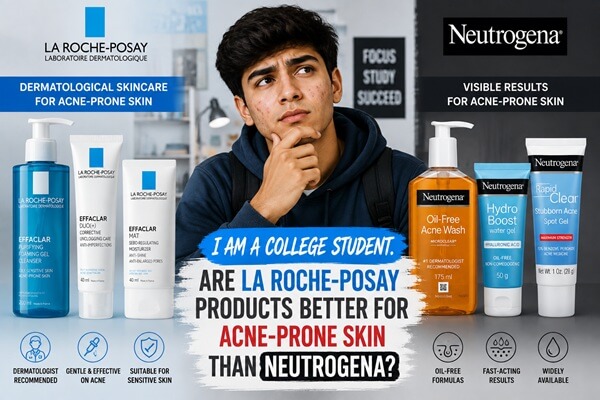
i am a college student. are la roche-posay products better for acne-prone skin than neutrogena?
| For sensitive, easily irritated acne-prone skin, La Roche-Posay generally has the edge, since its Effaclar line pairs proven acne ingredients with barrier-supporting extras like thermal spring water and niacinamide, making it easier to stick with long-term. Neutrogena is the stronger pick if you have tougher, oilier skin that tolerates stronger actives well and you need something effective on a tight student budget. Neither brand is objectively better across the board; it depends on how reactive your skin is and how much you want to spend. |
Between 8 a.m. classes, dining hall food, stress before exams, and pillowcases that don’t get washed nearly as often as they should, college is basically a breeding ground for breakouts. If you’ve started noticing more blackheads, random cystic bumps along your jaw, or just an oilier T-zone since moving into a dorm, you’re dealing with something extremely common, not a personal failure of hygiene. The real question is which drugstore brand is actually going to help: La Roche-Posay, the French pharmacy brand your friend swears by, or Neutrogena, the one that’s been in every drugstore acne aisle for decades.
Both brands genuinely work. They just take different approaches, and picking the wrong one for your specific skin can mean paying more for a product that leaves you red and flaky, or saving money on something too mild to touch your actual breakouts. Here’s how they actually compare, ingredient by ingredient, so you can stop guessing.
Why College Specifically Makes Acne Worse
Before comparing products, it helps to understand why your skin might be acting up more now than it did in high school. Stress raises cortisol, which increases oil production. Irregular sleep schedules mess with your skin’s natural repair cycle. Dining hall food tends to be higher in refined carbs and sugar than what most people ate at home, and there’s reasonably good evidence linking high-glycemic diets to worse acne in some people. On top of all that, dorm pillowcases, shared bathroom counters, and gym equipment introduce more bacteria and oil transfer to your face than most people account for.
None of this means your skin is doomed for four years. It means a consistent, well-matched routine matters more now than it probably ever has, which is exactly why picking the right brand, not just any acne product, is worth the extra ten minutes of research.
The Two Brands’ Philosophies, in Plain English
La Roche-Posay is a French pharmacy brand built around the idea that acne treatment shouldn’t come at the cost of a wrecked skin barrier. Its flagship Effaclar line combines legitimate acne-fighting ingredients with soothing additions like thermal spring water and niacinamide, and a large share of its products are fragrance-free and formulated specifically with sensitive, reactive skin in mind. The brand’s whole pitch is that you can treat acne and keep your skin comfortable at the same time, rather than choosing one or the other.
Neutrogena takes a more straightforward, effectiveness-first approach. It offers some of the most widely used over-the-counter acne treatments in the world, often at meaningfully lower prices, built around strong concentrations of proven actives. The tradeoff is that Neutrogena’s formulas tend to prioritize results over comfort, which can mean more dryness or irritation for people whose skin doesn’t tolerate strong actives well.
Ingredient Comparison: What’s Actually Fighting Your Acne
| Ingredient | Where It Shows Up | What It Does |
| Salicylic acid | Neutrogena Oil-Free Acne Wash; LRP Effaclar Medicated Gel Cleanser (2% + LHA) | Oil-soluble, penetrates pores to clear out excess oil and dead skin; good for blackheads and whiteheads |
| Benzoyl peroxide | Neutrogena Rapid Clear line (2.5-10%); LRP Effaclar Duo (+) (5.5%) | Kills acne-causing bacteria by releasing oxygen into pores; bacteria don’t develop resistance to it the way they can with antibiotics |
| Adapalene (retinoid) | Both brands offer OTC adapalene gel | Prevents new clogged pores from forming; best for long-term prevention rather than fast spot treatment |
| Niacinamide / thermal spring water | Mostly La Roche-Posay Effaclar products | Calms inflammation and supports the skin barrier alongside the active acne ingredients |
| Hyaluronic acid / glycerin | Common in Neutrogena moisturizers | Adds lightweight hydration without heavy oils that could clog pores |
A detail worth knowing: research on benzoyl peroxide has repeatedly found that a 2.5 percent concentration works about as well as 5 or 10 percent for most people, while causing noticeably less dryness and irritation. If you’re picking between a Neutrogena product at 10 percent BPO and a La Roche-Posay product at 5.5 percent, you’re not necessarily giving up effectiveness by going with the gentler option, you might just be avoiding unnecessary irritation for similar results.
Cleansers: Round One
Neutrogena’s Oil-Free Acne Wash has been a go-to for decades, built around salicylic acid to cut through oil and unclog pores. It works, and plenty of people see clearer skin with consistent use, but a common complaint is that it can leave skin feeling tight or stripped, especially with daily use in dry winter months or dorm rooms with harsh heating.
La Roche-Posay’s Effaclar cleansers, particularly the Medicated Gel Cleanser with 2 percent salicylic acid and LHA, target the same oil and congestion problems but are formulated to preserve more of the skin’s natural barrier while doing it. For most people with reactive or easily dried-out skin, this is where La Roche-Posay’s advantage is most noticeable day to day, since a cleanser you actually enjoy using twice a day is one you’ll stick with.
Treatments and Spot Fixes: Round Two
This is where Neutrogena tends to pull ahead for raw firepower. Its Rapid Clear Stubborn Acne Spot Gel and similar products offer higher benzoyl peroxide concentrations, up to 10 percent, giving you a stronger option for a stubborn, angry breakout the night before an important presentation. If your skin can tolerate it, that extra strength can mean faster visible results.
La Roche-Posay’s Effaclar Duo (+) takes a more measured approach at 5.5 percent benzoyl peroxide, pairing it with ingredients meant to reduce redness and marks left behind after a pimple heals. For people whose skin reacts to strong actives with peeling or redness, this is generally the safer starting point, even if it may take slightly longer to see the same level of improvement on a single stubborn spot.
Moisturizers: The Step Everyone Skips (But Shouldn’t)
A lot of acne-prone people, college students especially, skip moisturizer entirely out of fear it’ll make things oilier. That’s usually a mistake. Skipping moisturizer while using strong acne actives often makes your skin overcompensate by producing more oil, or just leaves it painfully dry and more prone to irritation from the actives you’re already using.
La Roche-Posay performs particularly well in this category. Products like the Effaclar Mat and Double Repair moisturizer are built to hydrate without clogging pores, specifically designed to pair with the brand’s own acne treatments. Neutrogena’s oil-free moisturizers, built around hyaluronic acid and glycerin, are a solid lightweight option too, and tend to be more affordable, though some users report they feel slightly less substantial on very dry or flaky skin.
Which Brand Fits Which Skin Type
Oily skin that tolerates strong products well: Neutrogena, since its higher-concentration options give you more firepower against genuinely oily, breakout-prone skin.
Sensitive or easily irritated acne-prone skin: La Roche-Posay, since its formulas are built specifically to avoid the dryness and redness that stronger treatments can cause.
Tight student budget, need something that works now: Neutrogena tends to be the more affordable option at most drugstores and big-box stores near campus.
Recurring breakouts plus general redness or reactivity: La Roche-Posay’s combination of treatment and barrier support tends to hold up better over a full semester of consistent use.
A Simple, Budget-Friendly Routine for Students
- Cleanse morning and night with a salicylic acid cleanser, either brand works, just stay consistent rather than switching products every few weeks.
- Apply a treatment product, benzoyl peroxide or adapalene, to active breakouts or all over if used for prevention, following the product’s specific instructions.
- Always follow with a lightweight, oil-free moisturizer, even if your skin feels oily. Skipping this step is one of the most common reasons acne treatments stop working over time.
- Wash your pillowcase at least once a week, more if you have long hair or use hair products, since dorm laundry schedules often let this slide longer than they should.
- Introduce only one new active ingredient at a time, spaced about two weeks apart, so you can actually tell what’s helping and what’s causing irritation.
Common Mistakes College Students Make
- Using a strong benzoyl peroxide product every single day right away instead of starting every other day and building up tolerance.
- Skipping moisturizer because oily skin feels counterintuitive to hydrate.
- Switching products constantly after only a few days, when most acne ingredients take four to six weeks of consistent use to show real results.
- Picking at or popping pimples during late-night study sessions, which increases the risk of scarring and prolongs healing.
- Assuming a more expensive product is automatically more effective, when concentration and consistency of use matter far more than brand price point.
A Closer Look at Each Brand’s Core Lineup
La Roche-Posay’s Effaclar range is genuinely built as a system rather than a collection of standalone products. The Medicated Gel Cleanser handles daily oil and congestion, Effaclar Duo (+) serves as the main spot and all-over treatment at 5.5 percent benzoyl peroxide, and Effaclar Mat or the Double Repair moisturizer close out the routine with oil-free hydration. The brand also sells a dedicated adapalene gel for people who want a long-term, prevention-focused retinoid without a prescription. Because these products are formulated to work together, a lot of dermatologists recommend building a routine entirely within one line rather than mixing and matching across a brand’s full catalog.
Neutrogena’s acne lineup is broader and slightly more fragmented, which has upsides and downsides. The Oil-Free Acne Wash remains the brand’s signature cleanser, while the Rapid Clear line covers spot treatment at multiple benzoyl peroxide strengths for people who want to choose their own intensity. Neutrogena also sells its own adapalene gel, essentially identical in active ingredient to La Roche-Posay’s version, and a range of oil-free moisturizers built around hyaluronic acid and glycerin. The tradeoff for Neutrogena’s wider selection is that it takes a bit more research to figure out which specific product within the lineup is right for your skin, rather than just picking the Effaclar equivalent and moving on.
Don’t Forget Sunscreen
This gets left out of almost every acne comparison, but it matters more than people think, especially for college students who are outside walking to class regardless of weather. Both benzoyl peroxide and adapalene can increase your skin’s sensitivity to sun exposure, and unprotected sun exposure on top of active acne treatment increases the risk of dark marks and prolonged redness after a breakout heals. Both La Roche-Posay and Neutrogena make well-regarded, non-comedogenic sunscreens, and adding one to your morning routine, even just on days you’re spending real time outside, will noticeably improve how fast your skin actually looks clear rather than just technically acne-free but blotchy.
The Real Cost Over a Semester
Sticker price alone doesn’t tell the full story. A Neutrogena cleanser and spot treatment combo often costs noticeably less upfront than the La Roche-Posay equivalent, but La Roche-Posay products are frequently sold in larger sizes or last longer per use, since a little goes a long way with their gel and cream textures. Over a full fifteen-week semester, the actual cost difference between building a full routine in either brand tends to be smaller than the shelf price suggests, especially once you factor in that a harsher, more irritating routine sometimes means buying an extra moisturizer or soothing product to compensate for dryness it caused in the first place.
Campus bookstores rarely stock either brand well, but most major pharmacy chains near a college campus, along with big-box stores, carry both lines in full, and both brands regularly run sales that can meaningfully close the price gap. Buying travel-sized versions first before committing to full-size bottles is a reasonable way to test which brand your skin actually prefers without wasting a semester’s skincare budget on a product that ends up irritating you.
Over-the-counter products from either brand are genuinely effective for mild to moderate acne, but they have limits. If you’re dealing with painful, deep cystic breakouts, acne that’s leaving noticeable scarring, or breakouts that haven’t improved after two to three months of consistent over-the-counter use, that’s a reasonable point to see a dermatologist rather than continuing to cycle through drugstore products. Many campus health centers offer dermatology referrals or basic acne treatment at a reduced cost for students, which is worth checking before assuming professional treatment is out of budget.
What Dermatology Research Actually Backs Up
It’s worth grounding this comparison in what’s actually been studied, rather than just brand marketing. Salicylic acid’s effectiveness for mild to moderate acne, particularly blackheads and whiteheads, is well established in dermatology literature, largely because its oil solubility lets it penetrate directly into clogged pores in a way water-soluble ingredients can’t. Benzoyl peroxide has an even longer track record, used clinically for over five decades, with the added benefit that acne-causing bacteria don’t develop resistance to it the way they can with topical or oral antibiotics, which is part of why dermatologists frequently recommend pairing it with other treatments rather than relying on antibiotics alone.
Adapalene, available over the counter in both brands’ lineups, has a slightly different research profile: it’s less about treating active breakouts quickly and more about preventing new ones from forming by regulating skin cell turnover inside the pore itself. That’s why dermatologists typically describe it as a maintenance ingredient, one that needs weeks of consistent use before its benefits become obvious, rather than a fast fix for an active flare-up. Knowing this distinction helps set realistic expectations for either brand’s adapalene product, since expecting overnight results from an ingredient designed for long-term prevention is one of the most common reasons people give up on a good routine too early.
Building Tolerance Without Wrecking Your Skin
One detail that gets glossed over in a lot of acne guides: your skin needs time to adjust to active ingredients, regardless of which brand you choose. Starting benzoyl peroxide or adapalene every day right out of the gate is one of the most common reasons people experience excessive dryness, peeling, or irritation in the first two weeks, and it’s also one of the most common reasons people wrongly conclude a product doesn’t work for them. Starting every other day for the first one to two weeks, then gradually increasing to daily use as your skin adjusts, applies equally whether you’re using La Roche-Posay or Neutrogena, and it’s a simple change that meaningfully improves how well either brand’s stronger treatments are tolerated over a full semester.
When It’s Time to See a Dermatologist Instead
Over-the-counter products from either brand are genuinely effective for mild to moderate acne, but they have limits. If you’re dealing with painful, deep cystic breakouts, acne that’s leaving noticeable scarring, or breakouts that haven’t improved after two to three months of consistent over-the-counter use, that’s a reasonable point to see a dermatologist rather than continuing to cycle through drugstore products. Many campus health centers offer dermatology referrals or basic acne treatment at a reduced cost for students, which is worth checking before assuming professional treatment is out of budget.
Frequently Asked Questions
Is La Roche-Posay actually better than Neutrogena for acne? Not universally. It tends to be better for sensitive or easily irritated skin, while Neutrogena often wins on raw strength and price for tougher, oilier skin.
Can I mix products from both brands? Yes, plenty of people do, for example a Neutrogena cleanser with a La Roche-Posay moisturizer. Just avoid combining multiple strong actives, like two different benzoyl peroxide products, at the same time.
Which brand is cheaper for a student budget? Neutrogena is generally the more affordable option at most drugstores, though sales and student discounts can shift the price gap for La Roche-Posay significantly.
How long before I see results from either brand? Most acne ingredients, including salicylic acid, benzoyl peroxide, and adapalene, take four to six weeks of consistent use before you see a real difference. Don’t judge either brand after just a few days.
Is benzoyl peroxide or salicylic acid better for acne? They target different things. Salicylic acid is better for clearing clogged pores, blackheads, and whiteheads, while benzoyl peroxide is more effective against inflamed, bacteria-driven breakouts. Many routines use both.
Will these products work for hormonal acne along the jawline? They can help reduce the surface-level breakouts, but hormonal acne often responds better to a combined approach, sometimes including prescription treatment, so it’s worth discussing with a dermatologist if jawline breakouts are a recurring pattern.
Should I stop using moisturizer if my skin feels oily? No. Skipping moisturizer usually makes oiliness worse over time by triggering your skin to overproduce oil to compensate for the lost hydration.
Can stress from finals actually cause more breakouts? Yes. Stress raises cortisol levels, which can increase oil production and inflammation, making breakouts more likely during high-stress periods like exam weeks.
Bottom Line
Neither La Roche-Posay nor Neutrogena is the universal winner for acne-prone skin. If your skin is reactive, easily dried out, or gets irritated by strong treatments, La Roche-Posay’s Effaclar line is worth the slightly higher price for how much easier it is to stick with long-term. If your skin is oilier, tougher, and you’re working with a tight student budget, Neutrogena’s stronger, more affordable options can get real results. Whichever you pick, consistency matters more than the logo on the bottle, give any new routine at least a month before deciding whether it’s working.