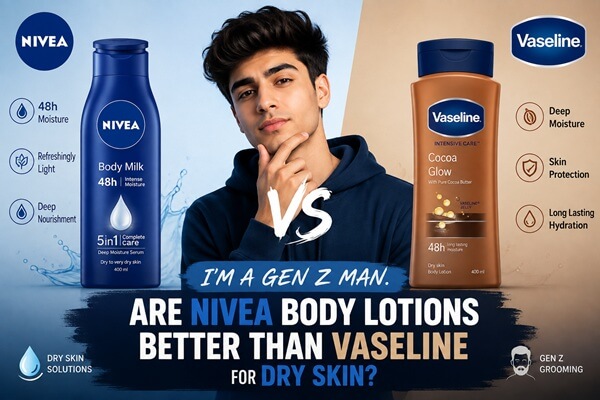
i am a genz man. are nivea body lotions better than vaseline for dry skin?
| Neither product is straight-up better. Nivea body lotions are the better daily pick for normal dry skin, ashy elbows, flaky legs, that tight feeling after a shower, because they combine humectants like glycerin with emollients like almond oil, sinking in fast without residue. Vaseline is the better call for genuinely cracked, severely dry, or barrier-damaged skin, since petroleum jelly is a pure occlusive that seals moisture in almost completely. If your skin is just dry, grab Nivea. If it’s cracking or bleeding, go Vaseline. |
You’re not imagining it. Your skin actually does get worse in your twenties, especially if you’re outside a lot, hitting the gym, running the AC or heater constantly, or just not drinking enough water between energy drinks. One day it’s fine, the next your shins look like they’ve been dusted with flour and your knuckles crack when you make a fist. So you walk into the pharmacy, see Nivea on one shelf and Vaseline on the other, and have zero idea which one actually fixes the problem instead of just making your skin greasy for twenty minutes.
Here’s the deal: this isn’t really a brand battle. It’s a chemistry question. Nivea and Vaseline aren’t competing products that do the same thing, they’re built on completely different moisturizing strategies. Once you understand that, the choice mostly makes itself, and you’ll stop wasting money buying the wrong one for what your skin actually needs. No influencer routine, no ten-step Korean skincare regimen required, just knowing which tool fits which job.
Quick Science: Why Your Skin Gets Dry in the First Place
Skin dryness happens when water evaporates out of your skin faster than your body can replace it, a process dermatologists call transepidermal water loss, or TEWL. Cold air, hot showers, harsh soap, AC, central heating, and even just genetics can all speed that process up. Once your skin’s outer barrier is compromised, it can’t hold onto moisture properly, which is exactly why the same shower that used to leave you fine now leaves you tight and flaky by the time you’re getting dressed.
Every moisturizer on the market works through one of three mechanisms: humectants, which pull water into the skin; emollients, which smooth and soften the surface; or occlusives, which physically block water from escaping. Understanding which category a product falls into tells you almost everything you need to know about how it’ll perform on your specific kind of dryness.
Nivea: Built on Humectants and Emollients
Nivea’s body lotion range leans heavily on glycerin, one of the most effective humectants available, paired with emollients like almond oil, shea butter, and light mineral oil. Glycerin pulls moisture into the skin from both the air and the deeper layers of your skin itself, while the emollients smooth the surface so it actually feels soft rather than just damp. The result is a lotion that absorbs in a couple of minutes, leaves zero greasy residue on your hands, and genuinely improves how your skin feels almost immediately.
Nivea’s Essentially Enriched Body Lotion, for example, is built specifically for dry to very dry skin, doubling down on almond oil and natural sea minerals, with the brand claiming hydration that holds up to 48 hours. For a guy who wants to moisturize once in the morning, throw on a shirt, and not think about his skin again until tomorrow, that fast-absorbing, no-residue profile is exactly what you want.
Vaseline: A Pure Occlusive, and That Changes Everything
Vaseline’s signature product, petroleum jelly, works completely differently. It is not a humectant and it is barely an emollient. It is almost purely occlusive, meaning it does not add hydration to your skin at all. What it does is form a near-impermeable seal over whatever moisture is already there, reducing water loss through the skin by more than 98 percent according to dermatological research on petrolatum. That is an enormous number, and it is why petroleum jelly has been a staple of dermatology for treating eczema, cracked heels, and severely compromised skin for well over a century.
Vaseline’s body lotion line, separate from the classic jelly, blends petroleum jelly with humectants like glycerin too, so it is not purely occlusive the way the jelly itself is. But even the lotion range leans more heavily on moisture-locking than Nivea’s does, which is why it tends to feel thicker and take a bit longer to fully sink in.
Side-by-Side: Nivea vs Vaseline for Dry Skin
| Factor | Nivea Body Lotion | Vaseline |
| Core mechanism | Humectant + emollient blend | Occlusive-dominant (jelly); humectant + occlusive blend (lotion range) |
| Best for | Everyday dryness, tight or flaky skin | Cracked, severely dry, or barrier-damaged skin |
| Texture | Creamy, absorbs in minutes, no residue | Thicker; classic jelly leaves a visible film |
| Speed of results | Fast surface improvement | Slower but deeper moisture-sealing over time |
| Fragrance | Often fragranced; some fragrance-free options exist | Fragrance-free classic jelly; lotions vary |
| Best use case | Morning routine, all-over daily moisturizing | Elbows, heels, knuckles, or overnight slugging |
| Price point | Budget-friendly, wide availability | Budget-friendly, wide availability |
Which One Wins for Different Situations
Everyday dry skin, tight after a shower: Nivea wins. The glycerin pulls moisture in fast, and you’re not walking around feeling coated in anything.
Cracked heels or knuckles: Vaseline wins, hands down. A thin layer over the cracked area seals it and gives skin a real chance to repair instead of splitting open again the next day.
After the gym or a workout: Nivea, since you don’t want a greasy layer sitting under your clothes while you’re still sweating.
Winter, especially cold and windy: Vaseline on exposed areas like lips, cheeks, and hands, since it blocks wind-driven moisture loss far better than a standard lotion.
Sensitive or fragrance-reactive skin: Vaseline’s classic petroleum jelly is fragrance-free by default; look specifically for Nivea’s fragrance-free lines if scent tends to irritate you.
Can You Use Both? (Yes, and Here’s the Right Order)
This isn’t an either-or situation if you don’t want it to be. A lot of guys with genuinely dry skin get the best results layering both: apply Nivea first to actually hydrate the skin, then seal specific rough spots, elbows, knees, cracked heels, with a thin layer of Vaseline on top. This taps into a real dermatology-backed technique sometimes called slugging, where a heavy occlusive is applied as the final step of a routine to lock everything underneath it in place overnight.
One thing worth knowing: petroleum jelly on its own does not hydrate dry skin, it just prevents moisture from leaving. If you slap Vaseline onto skin that’s already dehydrated with nothing underneath it, you’re sealing in dryness, not fixing it. Always moisturize first, then seal, not the other way around.
Step-by-Step: A Simple Routine That Actually Works
- Shower with lukewarm water instead of hot. Hot water strips your skin’s natural oils and makes dryness worse, no matter what you put on afterward.
- Apply Nivea body lotion within a few minutes of getting out, while your skin is still slightly damp. This traps extra moisture from the shower itself.
- For rough spots, elbows, knees, heels, follow up with a thin layer of Vaseline directly over those areas only.
- At night, if your hands or feet are especially bad, apply Vaseline generously and sleep in an old pair of socks or gloves for an intensive overnight repair.
- Drink water throughout the day. Topical products help the surface, but actual hydration still matters for skin that’s dry from the inside out.
A Closer Look at Nivea’s Product Lineup
Nivea doesn’t just sell one body lotion, and picking the right variant within the brand matters almost as much as picking Nivea over Vaseline in the first place. The Essentially Enriched line is formulated specifically for dry to very dry skin, built around doubled almond oil content and natural sea minerals, making it the closest thing to a heavy-duty option within Nivea’s range. The Nourishing Body Milk leans lighter, better suited for guys with normal to mildly dry skin who want quick absorption without much fragrance. Nivea Men also runs a separate line, typically formulated with slightly different scent profiles and marketed specifically toward guys who want something that doesn’t smell floral or overly sweet, worth checking out if fragrance is a dealbreaker for you.
One detail that trips people up: not every Nivea product is created equal for dry skin specifically. Their in-shower moisturizers and body washes, for instance, are convenient but noticeably less effective for genuine dryness than a proper leave-on lotion, since rinse-off products spend far less time in contact with your skin. If dryness is a real issue for you, stick to the leave-on lotions rather than assuming any Nivea product on the shelf will do the same job.
A Closer Look at Vaseline’s Product Lineup
Vaseline’s lineup splits cleanly into two categories: the original petroleum jelly, sold in tins and jars, and the broader Intensive Care lotion range, which blends petroleum jelly with humectants and other conditioning agents to create something closer to a traditional lotion. The classic jelly is your go-to for cracked heels, chapped lips, and severely dry patches, precisely because it’s almost purely occlusive. The Intensive Care and Advanced Repair lotions, on the other hand, are formulated to be used all over the body daily, closer in practical use to how you’d use a Nivea lotion, just with a heavier, more moisture-locking finish.
Vaseline also sells cocoa butter and aloe vera variants within its lotion range, aimed at guys who want some of the barrier-sealing benefits of the brand’s core technology without the classic jelly’s heavier feel. If you’ve tried the original tin and found it too greasy for daily use on your arms and legs, the Intensive Care line is worth trying before writing off the brand entirely.
Myths Worth Clearing Up
A lot of confusion around this comparison comes from a few persistent myths. The first is that petroleum jelly is somehow bad for your skin or unsafe, a claim with no real dermatological backing when it comes to cosmetic-grade, purified petrolatum, which is what goes into Vaseline products. Medical-grade petroleum jelly has been used in dermatology for over a century specifically because it’s inert, non-irritating for the vast majority of users, and extremely effective at what it does.
The second myth is that thicker automatically means better for dry skin. That’s not how moisturizing science works. A thick product that’s purely occlusive without any humectant support can actually trap dryness in place rather than fixing it, which is exactly why applying Vaseline to bone-dry, unmoisturized skin sometimes feels like it’s not doing much, because it isn’t adding any moisture, only sealing in whatever’s already there.
The third myth is that natural or plant-based automatically beats a classic drugstore formula. Shea butter, almond oil, and petroleum jelly are all, in their own ways, extremely well-studied and effective ingredients regardless of how they’re marketed. The ingredient list matters far more than whether a product markets itself as natural, clinical, or classic.
How to Tell Which Category Your Skin Actually Falls Into
If you’re still not sure whether you’re dealing with normal dryness or something more serious, a simple check helps. Normal dry skin usually looks slightly dull, feels tight after showering, and might flake a little on shins or elbows, but doesn’t crack, bleed, or catch on clothing. That’s Nivea territory. Severely dry or barrier-damaged skin shows visible cracks, especially on heels, knuckles, or knees, sometimes bleeds slightly, and can feel painful rather than just uncomfortable. That’s where Vaseline’s sealing power earns its keep. If you’re dealing with persistent redness, itching that won’t quit, or skin that looks inflamed rather than just dry, that’s worth a conversation with a dermatologist rather than something to solve with any over-the-counter lotion alone.
- Only moisturizing when skin is visibly flaking, instead of doing it daily as prevention.
- Using Vaseline alone on dehydrated skin expecting it to add moisture, when it only seals in what’s already there.
- Skipping moisturizer after the gym because it feels unnecessary, when post-shower dryness is often at its worst right after a workout.
- Ignoring fragrance as a trigger for irritation, especially on already-compromised or cracked skin.
- Buying a premium, expensive lotion when a basic fragrance-free Nivea or Vaseline product would solve the actual problem just as well.
What Actual Dermatology Research Says
The science backing petroleum jelly’s effectiveness isn’t just marketing. Dermatological studies have repeatedly shown that petrolatum reduces transepidermal water loss by well over 90 percent, making it one of the most effective single-ingredient occlusives available over the counter, which is exactly why it remains a first-line recommendation for conditions like eczema and severely compromised skin barriers. Glycerin, the workhorse behind most Nivea formulas, is similarly well studied as one of the most effective humectants in skincare, with a long track record of measurably improving skin hydration levels in clinical settings.
What this means practically: neither product is a gimmick. Both brands are leaning on genuinely effective, decades-proven ingredients. The difference is purely in which mechanism, adding moisture versus sealing it in, matches what your specific skin needs right now.
Is One Actually Cheaper Long-Term?
Both brands sit firmly in budget territory compared to specialty skincare, and neither has a meaningful price advantage over the other at typical drugstore sizes. Vaseline’s classic petroleum jelly tends to last longer per bottle since you only need a thin layer on specific spots, while Nivea’s lotion gets used more liberally across your whole body daily. If cost matters most, a small tub of Vaseline for trouble spots paired with a larger, cheaper bottle of basic Nivea lotion for daily use is the most economical combination for most guys.
Why This Matters More in Your Twenties Than You’d Think
Skin habits you build now genuinely compound over time. Sun exposure, dehydration, and neglecting basic moisturizing in your late teens and twenties don’t just cause short-term dryness, they contribute to how your skin ages over the following decades. Building a two-minute habit now, lotion after every shower, a thin layer of Vaseline on trouble spots when needed, costs almost nothing in time or money compared to the cumulative effect of ignoring dry, cracked skin for years. It’s one of the lowest-effort, highest-payoff habits you can build into an otherwise low-maintenance routine.
Frequently Asked Questions
Is Nivea or Vaseline better for dry skin overall? Neither is universally better. Nivea wins for everyday dryness and a fast, no-residue feel. Vaseline wins for severely dry, cracked, or barrier-damaged skin.
Can I use Vaseline as my only moisturizer? You can, but it works best on skin that’s already somewhat hydrated, since it seals moisture in rather than adding it. On very dehydrated skin, pair it with a lotion first.
Will Vaseline clog my pores if I use it on my face? Petroleum jelly is generally considered non-comedogenic, meaning it doesn’t clog pores for most people, but those prone to breakouts may still want to patch test before applying it to acne-prone areas.
Is Nivea good for sensitive skin? Many Nivea products contain fragrance, which can be a trigger for sensitive skin. Look specifically for the brand’s fragrance-free lines if you’re prone to irritation.
What’s the fastest fix for cracked heels? A thick layer of Vaseline applied at night, ideally under a pair of socks, is one of the most effective and cheapest fixes for cracked heels available over the counter.
Should I moisturize after every shower? Yes, especially if you already deal with dry skin. Applying lotion within a few minutes of showering, while skin is still damp, locks in extra moisture that would otherwise evaporate.
Is slugging with Vaseline actually worth trying? For very dry or compromised skin, yes. Applying a thin layer as the final step of a nighttime routine can meaningfully improve barrier repair overnight, as long as you’ve hydrated first.
Does drinking more water actually help with dry skin? It supports overall skin health, but topical moisturizers still do most of the heavy lifting for surface-level dryness. Hydration and good moisturizing habits work best together, not as substitutes for each other.
Can Nivea and Vaseline be used together in the same routine? Yes. A common and effective approach is Nivea lotion all over for daily hydration, with Vaseline layered on top of specific rough spots like elbows, knees, or heels.